

The First Time I Saw Gyeongbokgung, I Almost Cried
I’m not particularly sentimental about tourist attractions. I’ve seen a lot of them — crowded, overpriced, and somehow less impressive in person than in photos. So when I first walked through the main gate of Gyeongbokgung Palace on a cold November morning, I wasn’t expecting much. But when the Gwanghwamun Gate opened up into that enormous courtyard with Gwanghwaemun stretching out ahead and the mountains behind it — yeah, I stood there like an idiot for a few minutes just staring.
Gyeongbokgung is the largest and most historically significant of Seoul’s five grand palaces. Built in 1395 during the Joseon Dynasty, it served as the main royal residence for over two centuries before being largely destroyed by Japanese colonial authorities in the early 20th century. What you see today is a restoration project that’s been ongoing since the 1990s — and it’s genuinely impressive even if some of the buildings are newer than they look.
This guide covers what I’ve learned across multiple visits, including the mistakes I made so you don’t have to.
Getting There
Gyeongbokgung is on Seoul Metro Line 3 — Gyeongbokgung Station, Exit 5. You walk straight out of the exit and the main gate is right there. Seriously, you cannot miss it. It takes about 5 minutes from the Gwanghwamun intersection to reach the ticket booths.
From central areas like Myeongdong or Hongdae, you’re looking at about 20 to 30 minutes on the subway. From Insadong, it’s a pleasant 15-minute walk if the weather cooperates.
Taxis are an option but honestly unnecessary. The subway drop is perfect and parking around the palace is limited and expensive — around 3,000 won per 30 minutes in nearby lots.
Ticket Prices and Hours
As of 2025, admission is 3,000 won for adults (ages 19–64). Children under 7 and seniors 65 and older get in free. If you’re visiting multiple palaces, the combined ticket for all five royal palaces costs 10,000 won and is genuinely worth it if you plan to see more than two.
Opening hours shift by season:
- March to May (Spring): 9am to 6pm, closed Tuesdays
- June to August (Summer): 9am to 6:30pm, closed Tuesdays
- September to October (Autumn): 9am to 6pm, closed Tuesdays
- November to February (Winter): 9am to 5pm, closed Tuesdays
Tuesday closures catch a surprising number of visitors off guard. I’ve seen people show up on Tuesdays looking baffled. Don’t be that person — double-check before you go.
The Royal Guard Changing Ceremony
One of the most popular things to witness at Gyeongbokgung is the Royal Guard Changing Ceremony at the main gate. It happens multiple times daily — typically at 10am, 1pm, and 3pm — and lasts about 20 minutes. The ceremony features guards in elaborate traditional uniforms with drums, flags, and highly choreographed movements.
It’s free with admission. The crowd gets thick, especially on weekends, so arrive 10 minutes early to get a decent viewing spot. Standing to the side slightly gives you a better angle than being packed into the center with everyone else.
I was surprised to find that the ceremony is cancelled when it rains, so if you’re visiting on a wet day, don’t plan your schedule around it.
What to See Inside
Geunjeongjeon (The Main Throne Hall)
This is the centerpiece of the palace — the grand throne hall where official state functions were held. The building itself is stunning, with its double-tiered roof and the enormous stone-paved courtyard in front. The throne inside is visible through the open doors; you can’t enter but you get a good view.
The courtyard stones are original, worn smooth by centuries of use. There are rank markers arranged in rows in front of the hall indicating where officials would stand during ceremonies. It’s one of those details that sounds dry until you’re actually standing there imagining a court assembly from 600 years ago.
Gyeonghoeru Pavilion
This two-story pavilion sits on an artificial island in the middle of a rectangular pond and is one of the most photographed spots in all of Seoul. It was used for royal banquets and entertaining foreign envoys. The reflection in the water — especially in early morning or late afternoon light — is the kind of image you see on travel blogs constantly, and it actually does look that good in person.
Access to the pavilion itself is limited and requires a separate reservation through the Cultural Heritage Administration website (cha.go.kr). Spots are limited and book out weeks in advance during spring and autumn. If you don’t have a reservation, you can still photograph it from the surrounding path, which is honestly nearly as good.
Hyangwonjeong Pavilion
Smaller and quieter than Gyeonghoeru, this hexagonal pavilion on another island toward the northern end of the palace grounds is my personal favorite. It feels more intimate somehow. The curved wooden bridge (Chwihyanggyo) leading to the island photographs beautifully. In autumn, the trees around it turn, and the combination of red leaves, water, and traditional architecture is honestly ridiculous in the best way.
The National Folk Museum of Korea
Located within the palace grounds, this museum is included with your palace ticket and covers Korean daily life from prehistory to the modern era. It’s surprisingly engaging — and the outdoor exhibits include a traditional village reconstruction and a street recreating old Seoul. Budget an extra hour if you go in.
The children’s museum wing is separate and has a small entry fee, but unless you’re traveling with kids you probably won’t need it.
The National Palace Museum of Korea
Also within the grounds, this museum specifically focuses on royal artifacts from the Joseon Dynasty — ceremonial objects, court paintings, royal clothing, and documents. Free admission. It’s quieter than the folk museum and runs more scholarly, but the objects on display are genuinely impressive.
Wearing Hanbok: The Free Entry Hack
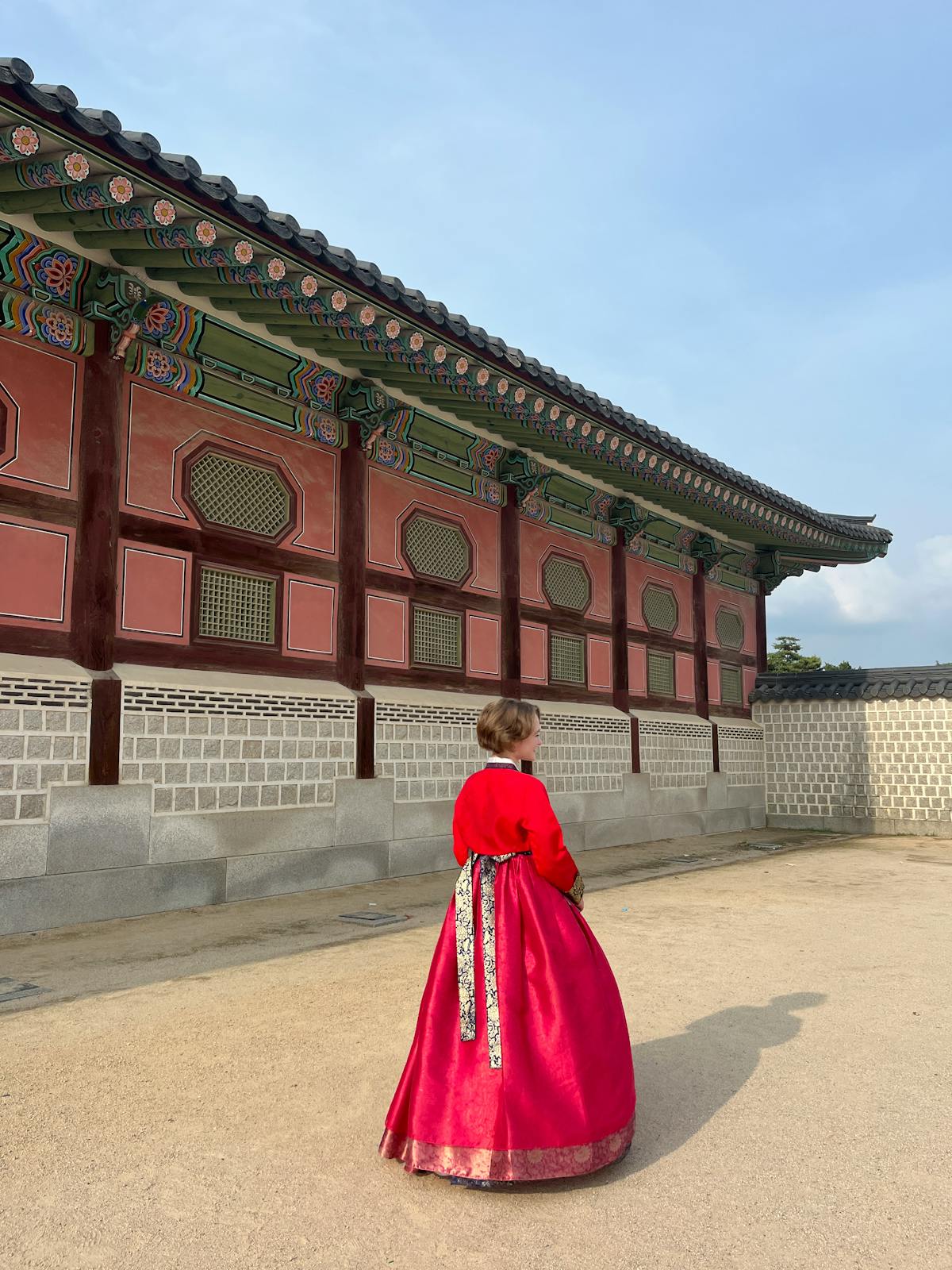
If you rent a hanbok (traditional Korean dress), admission to all five royal palaces is free. Hanbok rental shops are everywhere in the neighborhood near Gyeongbokgung, especially along the streets leading to the palace from Anguk Station. Prices run about 20,000 to 30,000 won for two to three hours — sometimes more for fancier options.
My biggest mistake was not doing this on my first visit. On a later trip I rented hanbok for about 25,000 won, got free entry, and the photos were completely different from anything I’d taken before. The palace was clearly designed to be the backdrop for people dressed that way. It just works.
The rental shops help you dress and often include hair accessories. Most are open by 9am or 9:30am. Some offer storage for your regular clothes while you wander.
Food and Drinks Near the Palace
There’s a small café inside the palace grounds near the folk museum — overpriced and average, as you’d expect from an in-venue spot. Skip it unless you’re desperate.
The better option is to walk five minutes to Insadong or 10 minutes to Bukchon Hanok Village for proper food. Insadong has dozens of traditional Korean restaurants; for a meal of bibimbap, doenjang jjigae, and tea for two people, you’re looking at around 15,000 to 25,000 won total at a mid-range place.
There’s also a good strip of cafés along the northern end of the palace wall heading toward Bukchon — quieter than Insadong, with better coffee and fewer tourists.
Best Time of Year to Visit
Autumn (late October to early November) is the peak season. The foliage around the palace and in nearby Bukchon is spectacular, and the light at that time of year has a quality that just doesn’t exist in summer. It’s also the most crowded time — weekends in October can be genuinely overwhelming.
Spring (April) is the second best time, especially when cherry blossoms are blooming. Similar crowds issue on weekends.
Summer is hot and humid, but early mornings are manageable and the crowds are somewhat lower on weekdays. Winter visits are cold but beautiful — especially after snow, when the palace grounds look like something out of a historical drama. The colors are stark and the atmosphere is completely different from the warmer months.
Combining With Nearby Attractions
Gyeongbokgung sits in a neighborhood packed with worthwhile stops. Bukchon Hanok Village is a 15-minute walk and makes for a natural combination — an afternoon at the palace followed by the maze of traditional houses as the light gets softer.
Insadong, the traditional arts and crafts street, is about 10 minutes away on foot from the palace’s Heunghwamun Gate side. It’s touristy but genuinely interesting — good for traditional snacks, tea, and craft shopping.
Changdeokgung Palace (including the famous Secret Garden, Huwon) is about 20 minutes on foot to the east. The Secret Garden requires a separate ticket and advance booking but is one of the most beautiful gardens in Korea. If you have a full day, the Gyeongbokgung → Bukchon → Changdeokgung Secret Garden route is arguably the best single day in Seoul.
What to Skip
The audio guide rental is okay but not necessary. Most of the information on the physical signs throughout the palace is sufficient, and there are good free apps for Korean palace sites. Save the 3,000 won.
The guided tours offered near the entrance are hit or miss depending on your guide and group size. If you prefer structure, the official Cultural Heritage Administration tours (bookable on cha.go.kr) are much better — smaller groups and more knowledgeable guides.
Practical Notes
The ground surface inside the palace is mostly stone or gravel — comfortable shoes are important. The palace is large enough that you’ll walk several kilometers over a full visit.
Photography is generally permitted throughout, including inside most of the pavilions (though not the National Palace Museum). The one exception is interior photography in the main throne hall during special events — just follow the posted signs.
There are accessible routes for wheelchair users and visitors with mobility limitations; ask at the entrance gate for the accessible path map.
Lockers are available near the main entrance for about 1,000 to 2,000 won if you want to stow a bag.
Last verified: May 2026. Information confirmed through direct experience and current sources. Something changed? Leave a comment and I’ll update it.

About Jay Han
Jay has lived in Seoul for over 10 years and works as a marketing professional. He started Korea Hub to share the kind of honest, specific information he wishes he’d had when navigating Korean culture, food, and travel for the first time. Not a travel blogger — just someone who actually lives here.
Gyeongbokgung in the early morning in winter — almost no one there, frost on the courtyard, the mountains behind — is a different place from the tourist-packed version. I’ve seen both and the quiet one stays with you.
More about Jay →