
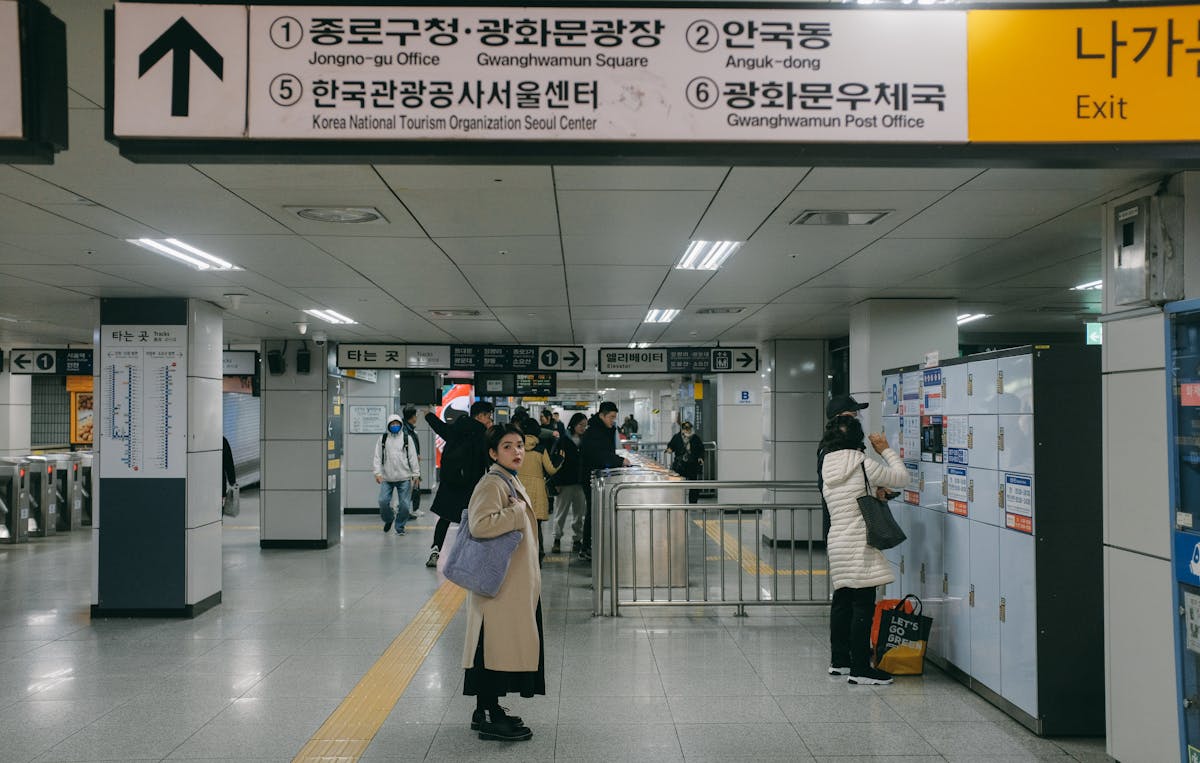
I take Line 2 every day. Not as a tourist — as someone going to work at 8:30am. The thing about living in this city is that you stop seeing the subway the way the guides describe it. You stop thinking “one of the world’s best subway systems.” You just think: okay, wrong platform again, or Sindorim is going to be terrible this morning.
I’ve been commuting on Seoul’s subway for years now. Here’s what the guides don’t tell you — because most guide writers visited for a week, not a workday.
Last verified: I actually commuted Line 2 express from Hongdae to Gangnam this past Tuesday, and double-checked the T-Money vs QR thing at Sinchon station on the way home.
🗺️ The Map Is Not As Scary As It Looks
Seoul has 23 lines. I know. But here’s what nobody tells you upfront: as a visitor, you’ll realistically use maybe six or seven of them. The rest exist for the outer districts and satellite cities. The map looks overwhelming because Seoul itself is enormous — 10 million people, 25 districts — but the color-coded system is genuinely well designed once you know which lines matter.
The lines that actually matter for most trips:
| Line | Color | Key Destinations |
|---|---|---|
| Line 1 | Dark Blue | Seoul Station, Dongdaemun |
| Line 2 | Green | Hongdae, Gangnam, Sinchon, Ewha — the main loop |
| Line 3 | Orange | Gyeongbokgung, Apgujeong |
| Line 4 | Sky Blue | Myeongdong, Dongdaemun History Park |
| Line 9 | Gold | Gimpo Airport → Gangnam (express) |
| AREX | Gray | Incheon Airport → Seoul Station |
| Sinbundang | Red | Gangnam tech corridor |
Every station sign is in Korean, English, and Chinese. The numbered station system means you don’t even need to read Korean — Line 2, Station 239, and so on. I relied on numbers almost exclusively for my first few months here.
Download Naver Map or Kakao Metro before you land. Specifically Kakao Metro for subway navigation — it tells you which car to board so you exit closest to the escalator at your destination. Sounds trivial. At 8:45am on a crowded platform, it is not trivial.
🚇 The Rush Hour Reality Nobody Writes About
Let me be honest about Sindorim station at 8:45am. It’s on Line 2 where Line 1 and Line 2 intersect, and it is genuinely not survivable in the way you’re imagining. I don’t mean it’s unpleasant. I mean there are uniformed station staff whose entire job is to push people into the cars so the doors can close.
I watched a tourist try to board at Sindorim on a Thursday morning once. He got on, looked around at the compression of human bodies, and — I don’t blame him — got off at the next stop and waited 20 minutes for a less-crowded train. Honestly the right call.
If your schedule allows any flexibility at all: shift morning trips to 9:30am or later. The difference in crowd density between 8:30am and 9:30am on Line 2 is the difference between a bad situation and a completely normal one. The stations that are specifically worst during morning rush: Sindorim, Hongdae, Gangnam, Guro Digital Complex. Use the far end of the platform — most people cluster near the center stairs.
Evening rush (5:30–8:00pm) is bad but more spread out, since people leave work at different times. Morning rush concentrates everyone into the same 90-minute window. You’ve been warned.
💳 T-Money Card vs QR Payment — The Actual Speed Difference
I tested this properly at Sinchon station last week because I was curious. T-Money tap: under a second, gate opens immediately. QR code payment via the Kakao Pay app: I had to unlock my phone, open the app, navigate to the QR screen, hold it up to the scanner. About 8–10 seconds total.
Eight seconds sounds like nothing. But at a busy exit gate with people behind you, eight seconds is genuinely long enough to hear someone sigh. And if your screen brightness is low or you have a case that partially covers the screen, the QR doesn’t always read on the first try. I’ve had it fail twice in a row at the same gate.
Get the T-Money card. This is not a genuine decision to agonize over. It’s ₩2,500 for the card itself at any CU, GS25, or 7-Eleven — and they’re right there in the airport arrivals hall as you exit customs. Load ₩30,000–50,000 for a week. Tap and go. Done.
Why T-Money Wins for Tourists
- ✅ Around ₩100 cheaper per ride than single-use tickets
- ✅ Works on subway, bus, taxis, and most convenience stores
- ✅ One tap per gate — no screen, no unlock, no loading
- ✅ Refund on remaining balance before you leave Korea
QR payment is genuinely fine if you’re a resident with the app already open and practiced. As a first-time visitor trying to figure out the gates at the same time, it adds friction you don’t need.
💰 What Rides Actually Cost
Seoul’s fares are distance-based, not zone-based. You pay for how far you actually travel.
| Distance | Fare (T-Money) |
|---|---|
| Up to 10 km | ₩1,400 |
| 10–50 km | ₩1,400 + ₩100 per extra 5 km |
| Over 50 km | ₩1,400 + ₩100 per extra 8 km |
In practice: roughly 80% of the trips you’ll take inside central Seoul cost ₩1,400–1,600. I’ve spent more on a single piece of toast here. The transfer system is also generous — if you transfer between subway and bus within 30 minutes, you pay only the distance difference, not a new base fare. Getting across the city costs less than you’d expect.
🪑 The Priority Seat Thing — What Tourists Actually Get Wrong
This one I see constantly and it’s worth explaining directly.
Korean subway cars have two types of seating: regular seats, and priority seats. The priority seats — sometimes pink or blue-tinted, always marked with symbols — are reserved for elderly passengers, pregnant women, and people with disabilities. These aren’t “suggest you give up your seat” zones. They’re empty-by-default zones. You don’t sit there even if the car is quiet and no one else needs them.
I’ve watched tourists sit in priority seats, notice an elderly person standing nearby, and genuinely not understand why the Korean passengers nearby look uncomfortable. The expectation here isn’t that you offer the seat when someone needs it. The expectation is that you never take it at all.
There are also pink-labeled women-only cars during rush hours — first and last car of each train. The signage on the platform is clear. Sit in those as a man and you’ll figure it out quickly from the body language around you.
🕐 Hours and Frequency
The subway runs from around 5:30am to around 1:00am daily, slightly later on weekends. The frequency during the day is every 2–5 minutes on major lines. You are almost never actually waiting for a train during normal hours — you’re mostly waiting for the crowd to thin enough to get on.
The last train matters. If you’re out in Itaewon on a Saturday night and it’s past midnight, you’re likely looking at a taxi home. Seoul taxis are fine and metered; using the Kakao T app means you know the fare before you commit. But if your hotel is across the city, the fare adds up. Know your last train time before your last drink.
You pay when you exit, not just when you enter. The system charges you based on total distance when you tap out. Don’t forget to tap out — if you skip it, the next time you tap in you’ll be charged the maximum fare. I did this twice in my first month. It’s around ₩2,000 in overpayment, which sounds like nothing, but it’s also just annoying. Tap out.
📱 The Apps Worth Having
Kakao Metro — For subway navigation. The standout feature is car-level guidance: it tells you exactly which car to board so you’re closest to the exit or escalator at your destination. Free. Download before you land.
Naver Map — For everything else. More accurate than Google Maps in Seoul for transit times and walking routes. Google Maps can be weirdly wrong about transit here — I’ve had it tell me to walk somewhere the subway handles in 4 minutes. Use Naver Map as your primary navigation.
Google Maps — Still useful for finding restaurants and browsing. Just not great for transit. Use alongside Naver, not instead of it.
🧭 A Few Things Worth Knowing
Platform side matters. Line 2 is a loop. “Hongdae direction” and “Sindorim direction” are both Line 2 but go opposite ways. The Kakao Metro app handles this automatically; if you’re navigating manually, always check the terminus name on the platform display.
Station exits can be very far apart. Each major station has multiple exits — sometimes 15 or more. The correct exit matters, because Exit 3 and Exit 9 might put you 700 meters apart on the street. The apps tell you the right exit. Manual navigation means you might walk the wrong direction for 10 minutes before figuring it out. I’ve done this more than I’d like to admit.
Eating on the subway is allowed but odd. You’ll occasionally see someone eating, but the general expectation is that you don’t. Koreans air-condition aggressively and eat at food courts in the stations, not in the cars. Grab an americano from the GS25 in the station and finish it before boarding — or wait until you exit.
The summer cold is real. Seoul air-conditions public spaces hard. In July or August, the train cars are noticeably cold — I carry a light jacket on the commute specifically for this. It sounds unnecessary until you spend an hour underground and step out feeling vaguely hypothermic into 32-degree heat. Bring something.
💡 Final Notes From Someone Who Uses This Daily
The Seoul subway is genuinely the easiest part of living here. I say this as someone who has gotten lost doing almost everything else in this city. The color coding works, the English signs are everywhere, the apps are excellent, and it runs until 1am for less than a dollar per trip.
Get the T-Money card. Download Kakao Metro. Avoid Sindorim between 8:00 and 9:30am if you value personal space. Everything else you’ll figure out on the train.
Before you board your first train:
If you’re arriving at Incheon Airport, I wrote a full breakdown of every airport-to-Seoul transport option — including which one I’d actually take and which ones I’d skip. And once you’re in the city, the T-Money card guide covers exactly how to set one up, where to top it up, and what happens if you run out of credit mid-ride. If you’re not sure which neighborhood to base yourself in, my guide to the best areas to stay in Seoul breaks down each district honestly — including which ones sound good but aren’t great for first-timers.

About Jay Han
Jay has lived in Seoul for over 10 years and works as a marketing professional. He started Korea Hub to share the kind of honest, specific information he wishes he’d had when navigating Korean culture, food, and travel for the first time. Not a travel blogger — just someone who actually lives here.
I’ve taken the subway at least 500 times since moving here. The first time I missed my stop at Sindorim because I was confused by the transfer system — now I could navigate it blindfolded.
More about Jay →