
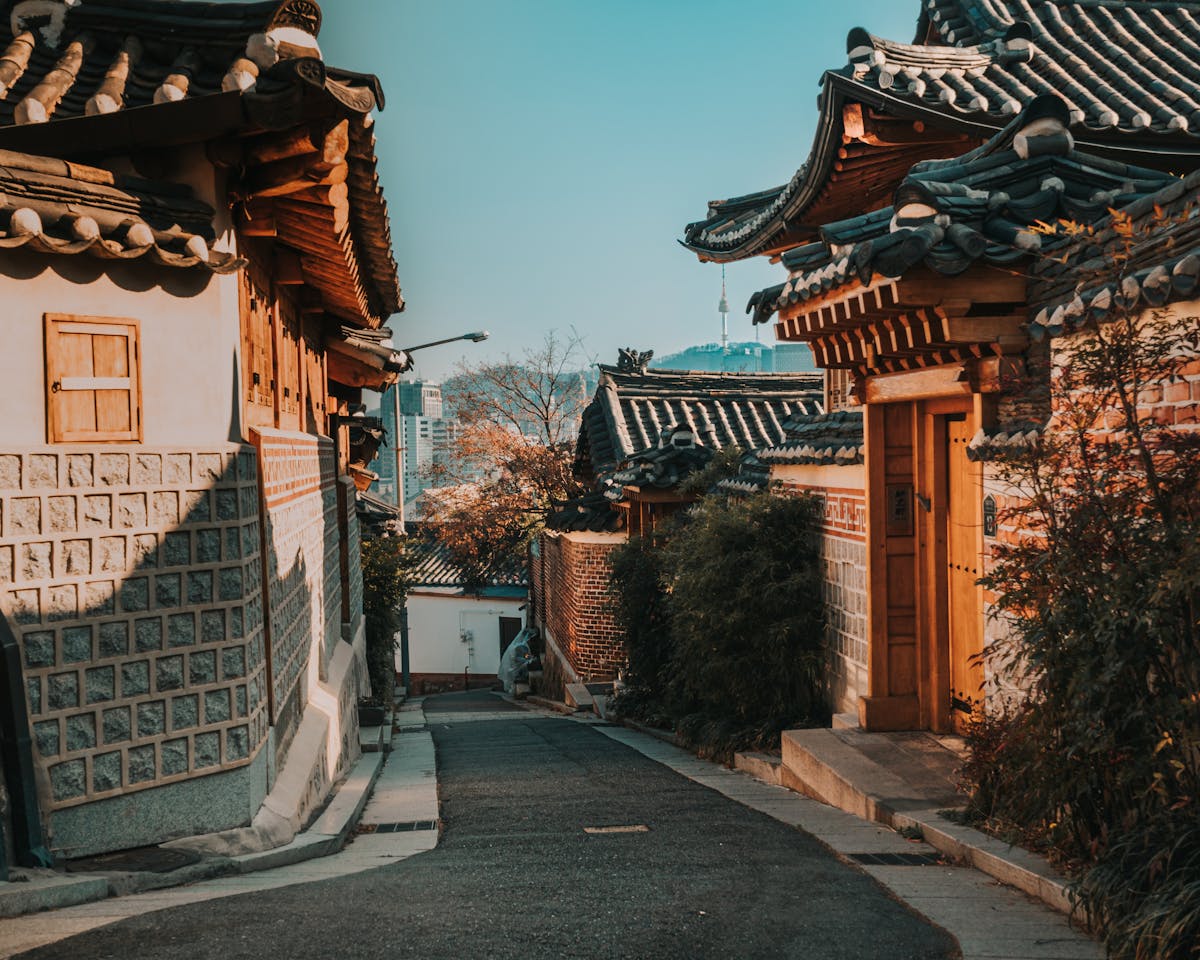
I’ve walked through Bukchon dozens of times. I pass by the main viewing point on my way to other things, occasionally. I know the neighborhood the way you know a route you’ve taken a hundred times—not always paying attention, but aware of it, aware of what it is.
Which is why I want to give you a version of this place that’s a little more honest than the Instagram version. The narrow alley with the curved tiled rooftops does look that beautiful in person. But it’s also real houses where real people live. And the experience of being there can range from genuinely moving to vaguely guilty, depending on how crowded it is and what time you show up.
Here’s what you actually need to know.
🏯 What Bukchon Actually Is
Bukchon—literally “north village”—is a residential neighborhood in central Seoul filled with hanok: traditional Korean wooden houses with the distinctive curved tiled roofs you’ve seen on every travel photo of Seoul. The area dates back to the Joseon Dynasty, roughly 1392–1897, and it sits on a hillside between two royal palaces: Gyeongbokgung to the west, Changdeokgung to the east.
Here’s the thing that surprises most visitors: people actually live here. This isn’t a theme park, a restored historical site, or a museum district. These are occupied homes. Some have been converted into small guesthouses, cafés, or cultural centers. Many have not. The family on the other side of that elegant wooden gate is going about their Tuesday.
The city of Seoul has designated Bukchon as a cultural preservation zone, which has created a slightly odd situation: one of Seoul’s most-visited neighborhoods is also a functioning residential community asking visitors to be quiet by 10 AM.
⚠️ Resident Privacy Rules — Read This Before You Go
Because it’s a residential area, Bukchon has rules that the city takes seriously—and that residents themselves will enforce if you’re not careful. I’ve seen confrontations. Don’t be that tourist.
- Quiet hours: No loud talking, shouting, or playing music. This is enforced and it’s not performative—there are residents sleeping and working.
- No photography inside private courtyards — if a gate is partially open, that’s not an invitation. Photograph the street, not through people’s front doors.
- Visiting hours: 10:00 AM – 5:00 PM. The city actively discourages early-morning visits because residents complained about being woken up by tourists at dawn.
- Respect the signage: Houses with “No Photography” signs mean it. The signs are bilingual.
I know this sounds like a lot of rules for a tourist destination. The reason there are rules is that there were visitors who needed them. Be the kind of tourist you’d want walking outside your home at 7 AM.
🗺️ Layout: The Areas Worth Exploring
Bukchon covers a significant area with several distinct sections. For most visitors, two areas matter most:
Gahoe-dong (the famous view)
This is where the iconic alley photograph is taken—the one with the row of hanok rooftops receding down a hill with the city visible behind them. The specific viewpoint is called Bukchon Hanok Village Viewpoint and it’s marked on every map. You’ll know it when you see the crowd of people with cameras pointed in the same direction.
The view is genuinely beautiful. Honestly. The curve of the rooftops against the modern city behind them is a contrast that never quite stops being striking, even for someone who’s seen it many times. But it’s also the most crowded spot, and the experience there depends heavily on when you arrive.
The quieter alleys
The more interesting exploration is away from the main viewpoint, in the smaller alleys that branch off the main routes. These require no particular navigation—just walk, turn where you feel like turning, and pay attention. You’ll find small galleries, craft shops, the occasional tea room with an open courtyard. The scale of the hanok up close, the quality of the old stone walls, the way the alleys frame the sky—all of this is better when you’re not competing with forty other people for the same angle.
🕰️ When to Go: The Honest Version
The photography-worthy experience requires timing. Here’s the breakdown:
Weekday mornings, 10–11 AM: The best option. Quiet, the light is good for photography, residents are going about their day, and you can actually absorb the place rather than navigate around other visitors. This is how Bukchon should be experienced.
Weekend mornings: Manageable before noon. After 11 AM on weekends, the main viewpoint gets genuinely crowded. Not oppressively so, but you’ll wait for the shot.
Weekend afternoons: The worst time. If you’re here in spring and it’s a Saturday afternoon, the famous alley looks like a queue for a popular ride—people standing in the specific spot, holding their phone up, moving on. The experience is fine if that’s what you’re here for. It’s not the contemplative wander you might have imagined.
Golden hour / evening: Bukchon is dark and quiet after 6 PM. The hanok are lit from within in some spots, and the atmosphere is actually lovely. But note the visiting hour guidelines—evening wandering in a residential neighborhood means being especially quiet.
🚇 Getting There
From central Seoul, the easiest routes:
- Anguk Station (Line 3, orange): Exit 2. Walk about 10 minutes uphill toward the village. This is the standard entrance point and most visitors arrive this way.
- Gyeongbokgung Station (Line 3): Exit 2, then walk east. You pass through the Insadong area first, which is worth stopping in.
There’s no parking worth mentioning—don’t drive here. The alleys are narrow and the area is clearly a walking destination.
🛕 What’s Nearby
Bukchon doesn’t exist in isolation—it sits in a corridor of Seoul’s most historically significant sites, and visiting it alone while missing the surroundings would be like eating one banchan from a Korean meal and leaving.
Gyeongbokgung Palace (10-minute walk west): The grandest of Seoul’s five Joseon palaces. Worth 2–3 hours, ideally more. Go early—the morning light through the main gates is the right time.
Changdeokgung Palace (10-minute walk east): The Secret Garden (후원) requires a separate timed-entry ticket and tour, but it’s one of the most beautiful spaces in Seoul. Book in advance, especially in autumn and spring when it fills up.
Insadong (15-minute walk south): Traditional craft shops, tea houses, art galleries, and streets that feel genuinely different from the rest of Seoul. Worth 1–2 hours.
Unhyeongung Palace (near Anguk station): Smaller, less famous, almost never crowded. If you want to see a historical palace without the crowds of Gyeongbokgung, this is it. Entry around ₩1,000, I think—almost nothing.
📷 Photography Tips (From Someone Who Lives Here)
The main viewpoint is at the top of a lane called Bukchon-ro 11-gil. You’ll see it on maps. The standard shot: stand at the viewing platform, frame the lane receding downhill with the hanok rooftops on either side and Seoul’s modern buildings in the distance.
Better shots are often found in the less-trafficked alleys—the textures of the old stone walls, the moss on rooftiles, the way the wooden gates have aged. These details are less Instagrammable and more genuinely interesting.
Early morning with mist is obviously perfect if you happen to be there on such a morning. I’ve never deliberately woken up early enough to engineer this. If you manage it, good for you.
🍵 Where to Rest
There are a handful of small cafés and tea rooms within and around Bukchon. Some occupy converted hanok, which means drinking tea in a room that’s a few hundred years old, which is strange and nice in equal measure. The prices are slightly elevated for the location, which is not unreasonable.
I usually grab an americano from the GS25 near Anguk station before heading up. Less atmospheric but perfectly adequate, and I’ve spent the price difference on something at the market on the way back.
💡 The Honest Takeaway
Bukchon is worth visiting. The architecture is genuinely beautiful, the hillside setting is unique, and the preservation of traditional structures in the middle of a modern megalopolis is remarkable in a way that’s easier to feel in person than to explain in words.
But it’s also a residential neighborhood that’s been partially overwhelmed by tourism, and the best version of it requires showing up with some consideration for that context. Go in the morning. Be quiet. Look at the houses rather than only photographing them. Walk past the main viewpoint into the smaller alleys.
The picture everybody takes from the famous spot is worth taking. But the thing that will actually stay with you is probably something smaller—a gate, a rooftile, a courtyard glimpsed through a window—that you found when you weren’t looking for it.
🎒 Combining Bukchon with a Full Day Itinerary
Bukchon fits naturally into a day structured around Seoul’s palace corridor. A logical day: start at Gyeongbokgung when it opens at 9 AM (morning light through the main gates is worth the early start), walk east through the Bukchon area around 11 AM, continue to Changdeokgung for the Secret Garden tour in the early afternoon, and finish in Insadong for dinner. This covers four distinct historical layers of Seoul in a single day without rushing any of them.
The walk between all these sites is manageable—mostly flat except the hillside portion of Bukchon itself—and the neighborhood transitions are interesting in their own right. You go from grand palace architecture to intimate residential lanes to UNESCO heritage gardens to craft market streets within about 2 kilometers. Seoul at its most layered.
Related Posts:
- pick the right Seoul neighborhood for your stay
- pick up the Korean phrases that matter in real situations
- navigate the Seoul subway system with confidence
Last verified: May 2026. Information confirmed through direct experience and current sources. If anything has changed, leave a comment and I’ll update it.

About Jay Han
Jay has lived in Seoul for over 10 years and works as a marketing professional. He started Korea Hub to share the kind of honest, specific information he wishes he’d had when navigating Korean culture, food, and travel for the first time. Not a travel blogger — just someone who actually lives here.
I walk through Bukchon a few times a year and I still notice something different each time. The first time I took that turn and suddenly had a view of the valley of hanok rooftops — I stopped walking for a minute.
More about Jay →