
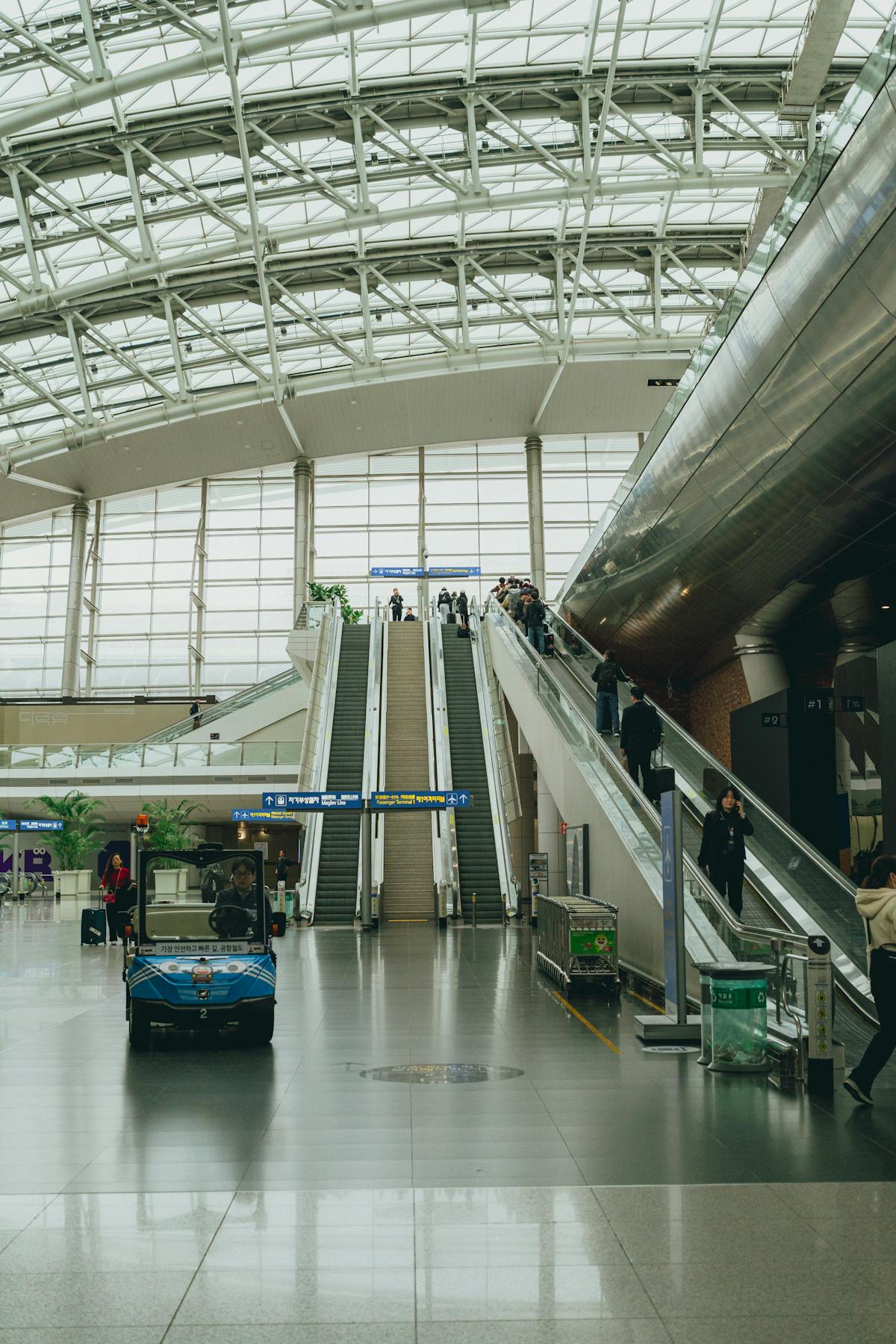
Let me tell you what I’d actually take — and what I wouldn’t — because the standard airport transport guides all tell you the same thing and none of them account for the part where you’re tired, possibly jet-lagged, and standing in a massive Korean airport trying to read signs for the first time.
I’ve done this route from both terminals. The experience is different depending on when you land, how much luggage you have, and whether you have a Korean SIM yet. Here’s what I’d actually do, not what looks best in a comparison table.
📍 First: Your First 30 Minutes After Landing
This is the part no guide covers properly, so I’ll do it step by step with actual times.
You land. You get off the plane. Here’s what happens next:
- Gate to immigration: 10–20 minutes walking, depending on which gate and which terminal. Incheon is enormous — genuinely one of the larger airports in the world. Don’t rush; you can’t skip the walk.
- Immigration queue: Variable. Early morning international arrivals can be 5 minutes. Peak times (late afternoon on summer weekends) can be 40–60 minutes. Budget this time.
- Baggage claim: 15–25 minutes typically after you clear immigration.
- Exit customs → arrivals hall: You’ll walk through a customs check. Usually fast unless you’re flagged. Then you’re in the arrivals hall.
From landing to the arrivals hall: budget 45–75 minutes. I know that sounds like a lot. It is a lot. Incheon doesn’t rush this process.
First things to do in the arrivals hall, in this order:
- Get a SIM card or pocket WiFi. The counters are immediately to your right as you exit customs. You need data before anything else. Having Naver Map working before you board the train changes everything.
- Get a T-Money card. CU or GS25 convenience stores are right there. ₩2,500 for the card, load ₩30,000–50,000. This covers the all-stop AREX and all Seoul subway rides. Bring your passport for the SIM.
- Then decide your transport.
🚄 What I’d Actually Take: The AREX
For most people, the right answer is the AREX. Either the express or the all-stop version depending on where you’re staying and how much you want to spend.
Express Train ✅
- Route: Incheon T1 → Seoul Station (direct, no stops)
- Time: 43 minutes
- Cost: ₩9,500
- Frequency: Every 30–40 minutes
- Hours: First train 5:20am, last train 11:00pm from the airport
I missed this train once. It was 8:30am on a Monday, I was rushing back from a work trip, and the schedule board at the T-Money counter was showing the all-stop times, not the express times. They look the same at a glance. I stood on the wrong platform for 20 minutes with my suitcase before I figured it out. The schedule boards are confusing if it’s your first time — look for “직통” (express, directly) vs “일반” (all-stop) on the platform display before you commit to a platform.
The express seats are reserved — you choose yours when you buy the ticket. The train is quiet, air-conditioned, has luggage racks. It’s fine. Nothing exciting, just functional in exactly the way you want when you’re tired from a flight.
All-Stop Train 💸
- Route: Incheon → Gimpo Airport → Digital Media City → Hongdae → Sinchon → Seoul Station
- Time: ~66 minutes to Seoul Station
- Cost: ₩4,150 with T-Money
- Frequency: Every 6–12 minutes
If you’re staying in Hongdae — which is a genuinely good base for first-time visitors — this is the better option. One train, ₩4,150, and you’re there. Hard to argue with that math. The T-Money card covers this one directly; you don’t need a special ticket.
Note on Terminal 2: Korean Air, Delta, Air France, and KLM land at T2. There’s now a direct T2 AREX stop — check the signs when you land, it should be clearly marked near baggage claim. Alternatively there’s a free shuttle from T2 to T1, which runs every 5–10 minutes and takes about 15 minutes.
🚌 Airport Limousine Bus: When It Makes Sense
The limousine buses run door-to-door routes between the airport and major hotels or neighborhoods. They’re coaches with luggage space, not actual limousines.
- Cost: ₩9,000–17,000 depending on the route
- Time: 60–90 minutes scheduled, can stretch significantly in traffic
- Where to buy: Bus counters on the arrivals floor, color-coded by route
The main catch: Seoul traffic. The AREX doesn’t get stuck. The bus does. I’ve been on a limousine bus that took 110 minutes when the schedule said 75 — a Friday evening, expressway crawl, nothing to do but stare at brake lights. Once was enough for me as a general transport choice.
That said: if your hotel is somewhere that requires a transfer and a walk from Seoul Station while dragging luggage — Insadong, northern Seoul neighborhoods — the direct bus drop might be worth the traffic uncertainty. Check if your specific neighborhood has a direct route before dismissing it.
🚕 Taxis: For Groups and Late Night
Taxis from Incheon aren’t cheap — ₩50,000–80,000 for central Seoul — but for a group of three or four splitting the fare, the math becomes reasonable. The official taxi queue is on the 1st floor arrivals level, not right outside customs. I watched about 20 tourists go outside first on a Saturday afternoon and then come back in confused, because the instinct is to exit and look for taxis on the street. They’re not on the street here. Follow the signs down to the 1F taxi rank.
Use the Kakao T app if you already have a Korean phone number — it lets you book in advance, see the estimated fare, pay by card in-app, and share the ride status with someone. The English interface is fine. But here’s the thing: Kakao T registration requires a Korean phone number to verify. If you don’t have a local SIM yet, the app won’t let you complete signup. I watched a friend try to register at the airport arrivals hall and spend 15 minutes on it before giving up. If you don’t have a Korean number yet, just get the AREX — it’s the cleaner option anyway. Download Kakao T before you arrive if you’re planning to use taxis throughout your trip and you’ll have a SIM sorted.
Regular taxi rank: orange taxis are standard, black ones (deluxe) are larger and charge more. Either works. Only take from the official rank — don’t accept offers from people approaching you inside the terminal.
For late-night arrivals (after 11pm when the AREX stops running), taxis are your main option. Budget ₩60,000–90,000 for central Seoul at that hour. Not a disaster, especially split between two people.
🚗 What I Wouldn’t Take: Rental Car
Renting a car at Incheon is possible. I wouldn’t do it for getting into Seoul specifically. Parking in Seoul is expensive and complicated, city traffic is dense, and the subway goes everywhere you’d want to go faster and cheaper. Rent a car if you’re planning a day trip to the countryside — driving within Seoul proper is more pain than it’s worth.
📱 Get Your Phone Working First — Seriously
Before you commit to any transport: grab a SIM or pocket WiFi in the arrivals hall. Having navigation before you get on the train is the difference between arriving at Seoul Station knowing exactly which subway exit to take, and arriving at Seoul Station having to ask someone or guess. The counters are right there as you exit customs. Bring your passport. Most tourist SIMs work immediately.
💡 A Note on Incheon’s Size
The airport is enormous. Allow more time than you think for both arrivals and departures. The walk from your gate to the AREX station can be 15–20 minutes. If you’re aiming for a specific train, factor this in — and check whether you’re in T1 or T2 before you commit to a plan, because that changes your options.
There’s also a duty-free mall inside that’s better than most airports’ setups — cosmetics, electronics, Korean snacks, competitive prices. If you have time before your departure flight, it’s genuinely worth a walk.
What to do once you’re actually in Seoul:
The subway system is going to be your main transport once you arrive, and my Seoul subway guide explains the things that actually confuse people in real life — not the map, but the rush hour reality and which platforms to avoid. Before you tap your card anywhere, make sure you understand how T-Money works — specifically what happens if your card balance hits zero mid-journey, which is a situation the AREX does not handle gracefully. And if you haven’t figured out where you’re staying, my breakdown of the best areas to stay in Seoul will save you from booking somewhere that sounds central but takes 45 minutes to get anywhere useful.

About Jay Han
Jay has lived in Seoul for over 10 years and works as a marketing professional. He started Korea Hub to share the kind of honest, specific information he wishes he’d had when navigating Korean culture, food, and travel for the first time. Not a travel blogger — just someone who actually lives here.
I’ve made this journey maybe forty times — picking up visitors, coming back from trips abroad, accompanying people for early morning flights. Every transport option has surprised me at some point.
More about Jay →