
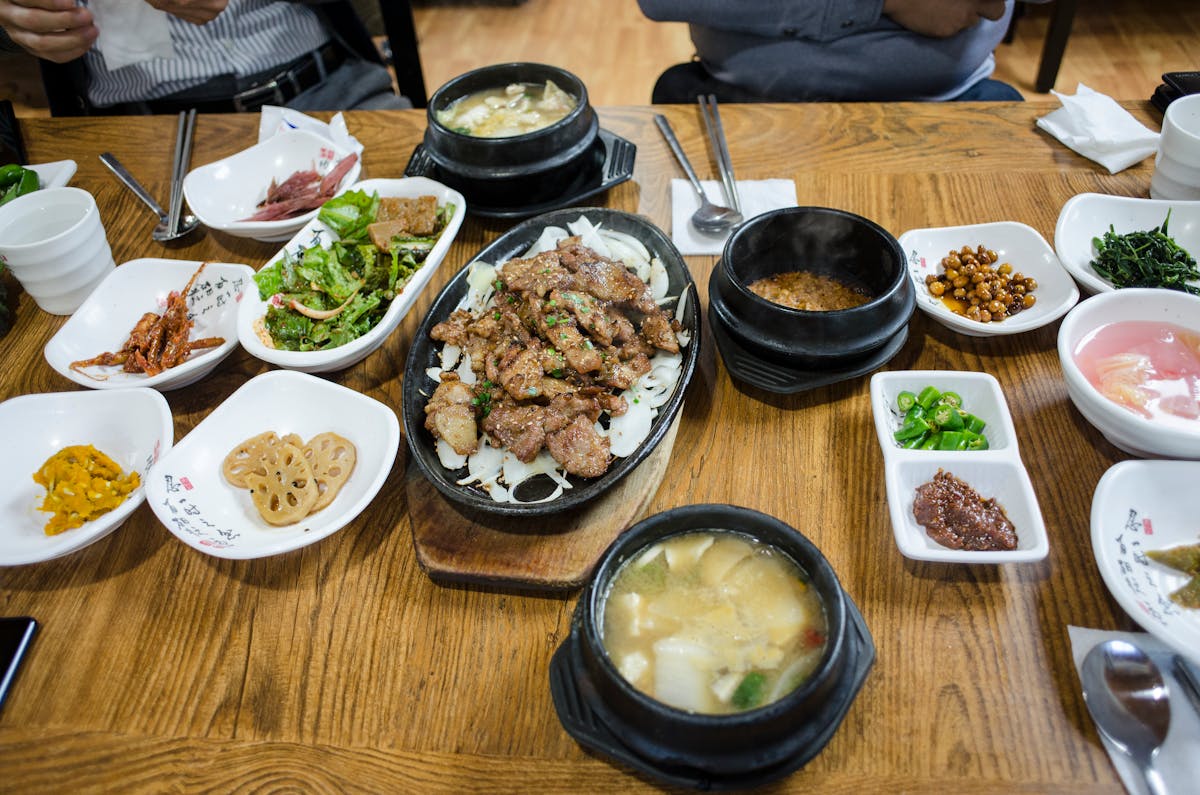
I’ve eaten most of these at places that don’t have menus in English. That’s not a flex — it’s just what happens when you live here long enough that the tourist-facing restaurants stop being your default. Here’s the actual order I’d recommend trying them, and where I’ve had the best versions of the ones that matter most.
Some notes before we start: I’ve tried to flag where I’ve actually been, because that’s the useful part. Generic recommendations of “go find a local restaurant” are not helpful. Specific recommendations get outdated, but they’re at least a real starting point. Prices are what I paid, roughly — things change.
🔥 Korean BBQ: Start Here
1. Samgyeopsal (삼겹살) — Grilled Pork Belly
If there’s one dish that captures how Koreans actually eat — the communal ritual, the shared grill, the wrapping and dipping and immediate consumption — it’s samgyeopsal. Thick-cut pork belly grilled at your table, wrapped in perilla leaves or lettuce with sliced garlic and a swipe of ssamjang. You eat it in one bite. Then you do it about thirty more times.
The charred fat, the crunch of raw garlic, the slight bitterness of the perilla — honestly, I’m not sure how to explain this in English in a way that does it justice. Just go.
Where I actually had this: There’s an unmarked samgyeopsal place in a basement in Mapo, near Mapo station exit 2, down the stairs between a pharmacy and a convenience store. No English sign. The owner pours your soju for you. Last time I was there — maybe three months ago — it was ₩14,000 per portion. The pork comes out still pink at the edges and you finish it on the grill yourself. I’ve gone back six times. I don’t know the name; I just know which staircase.
My tip: Order extra garlic to grill alongside the pork. Charred garlic on pork belly is one of the genuinely great combinations, and I’ll defend that.
2. Galbi (갈비) — Marinated Short Ribs
Beef short ribs marinated in a sweet-savory soy mixture, grilled over charcoal until the edges caramelize. More premium than samgyeopsal — the price reflects that — but the marinade does something to the meat that makes it worth it. Softer, richer, slightly sweet in a way that plays against the smokiness from the grill.
3. Bulgogi (불고기) — Marinated Beef
Thinly sliced beef in a sweet soy marinade, often cooked in a pan rather than over a grill. The marinade — soy sauce, sesame oil, pear for tenderizing, garlic — makes the beef genuinely tender in a way that feels almost luxurious for such a simple preparation. This is one of the more internationally recognized Korean dishes, and that reputation is deserved.
🍲 Soups and Stews: The Real Heart of Korean Cooking
If BBQ is what tourists come for, soups and stews are what Koreans actually eat every day. This is where the soul of the food is.
4. Kimchi Jjigae (김치찌개) — Kimchi Stew
Deeply savory, bubbling hot, arriving at your table still actively cooking in a stone pot. Made with well-aged kimchi, pork, and tofu. The sour funk of the kimchi transforms into something rich and complex when cooked down — it’s not a flavor you’ll forget.
Where I actually had this: The sundubu jjigae I keep going back to is actually at a different place, but for kimchi jjigae specifically, there’s a lunch spot near Hapjeong station, exit 3, down the alley past the convenience store. No English sign. It opens at 11am and closes at 9pm, closed Sundays. A bowl with rice is around ₩8,000 — it was ₩7,500 when I first found it two years ago, so prices have crept up slightly. The kimchi they use is properly aged — you can tell because the smell when the pot arrives is genuinely aggressive. That’s the right sign, not a bad one.
5. Doenjang Jjigae (된장찌개) — Soybean Paste Stew
Doenjang — I’m not sure how to explain this in English exactly, but imagine a Korean version of miso, except earthier, funkier, more complex. The stew made from it contains tofu, zucchini, mushrooms, and enough fermented depth that it seems impossible it’s one of the most common everyday foods in Korea. It’s also the most underrated thing you’ll eat here, probably because it doesn’t photograph well. Eat it anyway.
6. Sundubu Jjigae (순두부찌개) — Soft Tofu Stew
Soft, silky tofu in a bright red broth, arriving still violently boiling. Order it with seafood for the best version. A raw egg cooks in the heat as you eat. The texture of the tofu against the spice is something I still find hard to describe accurately — creamy and liquid at the same time, cutting against the heat.
Where I actually had this: My regular spot is a small sundubu chain near Yeoksam station, exit 7. The seafood version (해물 순두부) is ₩9,000, I think — maybe ₩9,500 now. They give you three banchan automatically, and the doenjang jjigae option is also excellent if you want to compare the two on the same visit. I go roughly once a week when work is stressful, which tells you something.
7. Gomtang (곰탕) — Bone Broth Soup
White, rich, collagen-heavy broth from beef bones cooked for hours. Almost the opposite of kimchi jjigae in flavor profile — mild, clean, deeply savory. Served with rice and pickled vegetables. The kind of thing you want when you’ve been walking all day and your feet hurt and you need something that feels like it’s rebuilding you.
8. Seolleongtang (설렁탕) — Ox Bone Soup
Similar to gomtang but milkier — the long cooking time emulsifies the collagen into a truly cloudy, rich broth. You season it yourself at the table with salt and scallions. Simple, perfect, underappreciated by visitors who go straight for the BBQ.
🍜 Noodles: The Other Korean Obsession
9. Jajangmyeon (자장면) — Black Bean Noodles
Korean-Chinese noodles in a thick black bean paste sauce with pork and vegetables. Technically a Korean-Chinese dish, but it’s been absorbed into Korean food culture completely — Koreans eat this on moving days, when they’re sad, when they want something comforting. The sauce looks like motor oil. It tastes like nothing you’ve had before.
10. Bibim Naengmyeon (비빔냉면) — Spicy Cold Buckwheat Noodles
Chewy buckwheat noodles — really chewy, more than you expect — in a bright red gochujang dressing with cucumber, pear, and boiled egg. Served cold. The texture and temperature together are the whole experience. Weirdly refreshing in summer.
Where I actually had this: Euljiro 3-ga has several naengmyeon places clustered near the old printing district. There’s one that’s been there long enough that the sign has faded. A bowl is around ₩10,000–11,000, I think. The noodles are genuinely chewier here than at the chain versions I’ve tried elsewhere — it matters more than you’d expect.
11. Mul Naengmyeon (물냉면) — Cold Noodles in Broth
Same buckwheat noodles, but in a cold, slightly tangy beef broth instead of the spicy sauce. The version I reach for on genuinely hot days. The cold broth is subtle and clean and the noodles have that slightly resistant texture that makes you work for each bite. Better than it sounds, which isn’t a great pitch, but it’s accurate.
12. Ramyeon (라면) — Korean Instant Ramen
Technically instant noodles, technically not a restaurant dish in most cases — but Korean ramyeon deserves mention because it’s genuinely different from Japanese ramen and from the cup noodles you know elsewhere. Buldak (fire chicken) ramyeon will test your limits. Shin Ramyun is the iconic entry point. Eat it from a 7-Eleven at 2am at least once.
🥘 Rice Dishes: The Foundation
13. Bibimbap (비빔밥) — Mixed Rice Bowl
Rice topped with seasoned vegetables, a fried or raw egg, gochujang, sesame oil, and usually some bulgogi or mushrooms. Mix everything from the bottom of the bowl before eating — vigorously. The version in a hot stone pot (dolsot bibimbap) creates crispy rice at the bottom that’s the best part. The Jeonju version is considered the original. If you pass through Jeonju, eat it there.
14. Gimbap (김밥) — Korean Rice Rolls
Rice and various fillings rolled in seaweed. Looks like sushi, tastes completely different — no raw fish usually, no vinegared rice, lighter and sesame-forward. Street food, convenience store food, everyday food. I grab these on the way to work about twice a week and I’m not embarrassed about it. ₩2,500–3,500 at a convenience store for a full roll.
15. Japchae (잡채) — Glass Noodle Stir-Fry
Sweet potato glass noodles stir-fried with vegetables and beef. The noodles are genuinely translucent, slightly sweet, with a texture that’s completely different from wheat or rice noodles. Usually served as a side dish or at celebrations. If it shows up as banchan somewhere, take more of it.
🌶️ Street Food: Eat While Standing
16. Tteokbokki (떡볶이) — Spicy Rice Cakes
Chewy cylindrical rice cakes in a thick, aggressively spicy gochujang sauce. This is street food at its most confrontational — the heat is immediate, not subtle. I burned my mouth on the first bite once because I don’t wait for things to cool down. Learned from that experience? Debatable.
Addictive. The sauce clings to the rice cakes in a way that means you’re eating three more before you’ve decided you like it. You will decide you like it.
17. Hotteok (호떡) — Sweet Pancakes
Fried dough pancakes filled with brown sugar, cinnamon, and nuts. Particularly associated with winter and spring. Eat them immediately while the filling is still molten inside. You’ll smell the vendor before you see the sign.
18. Gyeranppang (계란빵) — Egg Bread
Sweet dough baked with a whole egg set into it. Soft, slightly sweet bread with a savory egg core. Popular in Myeongdong and around markets. Costs around ₩1,500–2,000 depending on where you get it. Eat it while it’s warm.
19. Odeng / Eomuk (오뎅/어묵) — Fish Cake Skewers
Fish paste pressed into shapes, skewered, served floating in a light broth. You pick a skewer from the pot and eat it standing at the cart, drinking the broth from a small cup if you want. Classic autumn and winter street food. ₩500–1,000 per skewer.
20. Korean Fried Chicken
The double-frying technique creates a thin, shatteringly crispy crust on smaller pieces, then glazed with sauces from soy-garlic to gochujang. Served with pickled radish to cut the richness. The combination deserves the international reputation it’s developed. Order delivery from BBQ or Kyochon to your accommodation at least once — that experience is also part of it.
🥗 Fermented and Preserved: The Other Side
21. Kimchi (김치)
You think you know kimchi. In Korea, it varies enormously — by age, region, family recipe, vegetable. Baechu (napa cabbage) kimchi is the standard. Kkakdugi (radish) has a completely different texture. Oi sobagi (cucumber) kimchi is a revelation in summer. Eat kimchi everywhere, with everything, and pay attention to the variation.
22. Doenjang (된장) — Fermented Soybean Paste
This shows up as a dipping sauce alongside BBQ — fresh vegetables dipped directly in this pungent, savory paste. The smell is aggressive and the taste is deep and funky in a way that’s genuinely different from anything else. You either get it immediately or you need three tries. I needed three tries.
🍱 Restaurant Dishes Worth Sitting Down For
23. Dakgalbi (닭갈비) — Spicy Stir-Fried Chicken
Chicken, vegetables, and tteok stir-fried in a gochujang-based sauce on a large circular griddle at your table. The dish from Chuncheon is considered the original. Was it life-changing? Not quite what everyone promised. But genuinely good, especially toward the end when the sauce reduces and starts caramelizing at the edges of the pan.
24. Haemul Pajeon (해물파전) — Seafood Green Onion Pancake
A thick, crispy pancake loaded with green onions and seafood — shrimp, squid, oysters. The exterior should be genuinely crispy from the pan oil; the inside chewy and soft. Dipped in a soy-based sauce with vinegar. Best at a pojangmacha on a rainy day. I don’t know why rain specifically improves this food. It does.
Where I actually had this: There’s a pojangmacha area under the elevated highway near Noryangjin station that comes alive around 6pm on weekdays. The pajeon here is ₩10,000 for a large plate, served with extra dipping sauce, and the makgeolli pairing is ₩4,000 a bottle. I went last autumn on a rainy Thursday. I’ve thought about it several times since.
25. Galbi Tang (갈비탕) — Short Rib Soup
Beef short ribs slow-cooked in a clear, light broth until the meat slides off the bone. Simple, elegant, completely satisfying. One of those dishes where the effort shows in the subtlety of the flavor rather than its aggression.
26. Samgyetang (삼계탕) — Ginseng Chicken Soup
A whole small chicken stuffed with glutinous rice, jujubes, garlic, and ginseng, boiled until both the chicken and the rice inside become one soft thing. Eaten traditionally in the heat of summer. I ate it on a 33-degree day and it made more sense than I expected.
27. Bossam (보쌈) — Boiled Pork Wraps
Thick slices of boiled pork belly — softer and more delicate than the grilled version — wrapped in napa cabbage with kimchi and oysters. The contrast between tender pork, sharp kimchi, and fresh briny oyster in one bite is one of the more complex things you’ll eat here.
🍰 Desserts and Drinks
28. Bingsu (빙수) — Shaved Ice Dessert
Fine-shaved milk ice — not coarse snow-cone, more like powder — topped with red bean paste, mochi pieces, condensed milk. Mangobingsu with fresh mango in summer is the one I return to. The texture melts differently from any other shaved ice I’ve tried elsewhere, and I haven’t been able to explain why.
29. Sikhye (식혜) — Sweet Rice Drink
A traditional sweet beverage from fermented malt and rice — slightly sweet, slightly grainy, served cold. Available at traditional Korean restaurants as a digestif. Sounds strange. Works genuinely well after a heavy meal.
30. Makgeolli (막걸리) — Rice Wine
Milky, slightly fizzy, mildly sweet rice wine. Lower alcohol than soju, more textured, fermented rather than distilled. Traditionally paired with pajeon on rainy days — there is actually a Korean cultural association between rain and makgeolli. I’m not sure how to explain this in English exactly, but try them together once and you’ll understand it without explanation.
One Dish I’d Skip: Beondegi
Silkworm pupae (beondegi, 번데기). I tried it so you don’t have to.
It’s a real thing — sold in small paper cups at street stalls, warm and faintly steaming, smelling of something between soy sauce and something you don’t want to identify. I ate three. They tasted like the smell. I don’t regret trying it, but I’ve never felt the urge to go back. Some Korean foods take a few tries to appreciate. This one might require a different set of preferences than mine entirely.
💡 A Few Practical Notes
Korean restaurants typically serve several small side dishes (banchan) automatically — these are included in the price and usually refillable. Ask for more kimchi. The server will not be bothered.
Water is usually self-serve at a station in the restaurant. Help yourself.
Many Korean restaurants specialize in one dish, or a narrow range. The best kimchi jjigae places often have almost nothing else on the menu. That’s a good sign, not a bad one.
And honestly — the thing that changed how I ate here: stop planning so much. Walk until you smell something, find a place where the tables are mostly Korean families or office workers, and point at what looks good. The food here is genuinely excellent at every price level, and the random discovery is usually better than the researched recommendation.
A few things that connect to this:
Once you’ve eaten enough to feel confident, the Myeongdong shopping guide covers where to actually spend money versus what’s there just to extract cash from tourists. If you’re unsure about how much to tip after a meal (short answer: don’t), my guide to Korean tipping culture explains why, and what to do instead of awkwardly leaving bills on the table. And when you get stuck trying to read a menu with zero English, these 50 Korean phrases for travelers will actually help — I focused on the ones that come up in real situations, not classroom exercises.

About Jay Han
Jay has lived in Seoul for over 10 years and works as a marketing professional. He started Korea Hub to share the kind of honest, specific information he wishes he’d had when navigating Korean culture, food, and travel for the first time. Not a travel blogger — just someone who actually lives here.
My first year in Seoul, I ate gopchang by mistake at a company dinner. Didn’t know what it was. Loved it. Still order it deliberately.
More about Jay →