
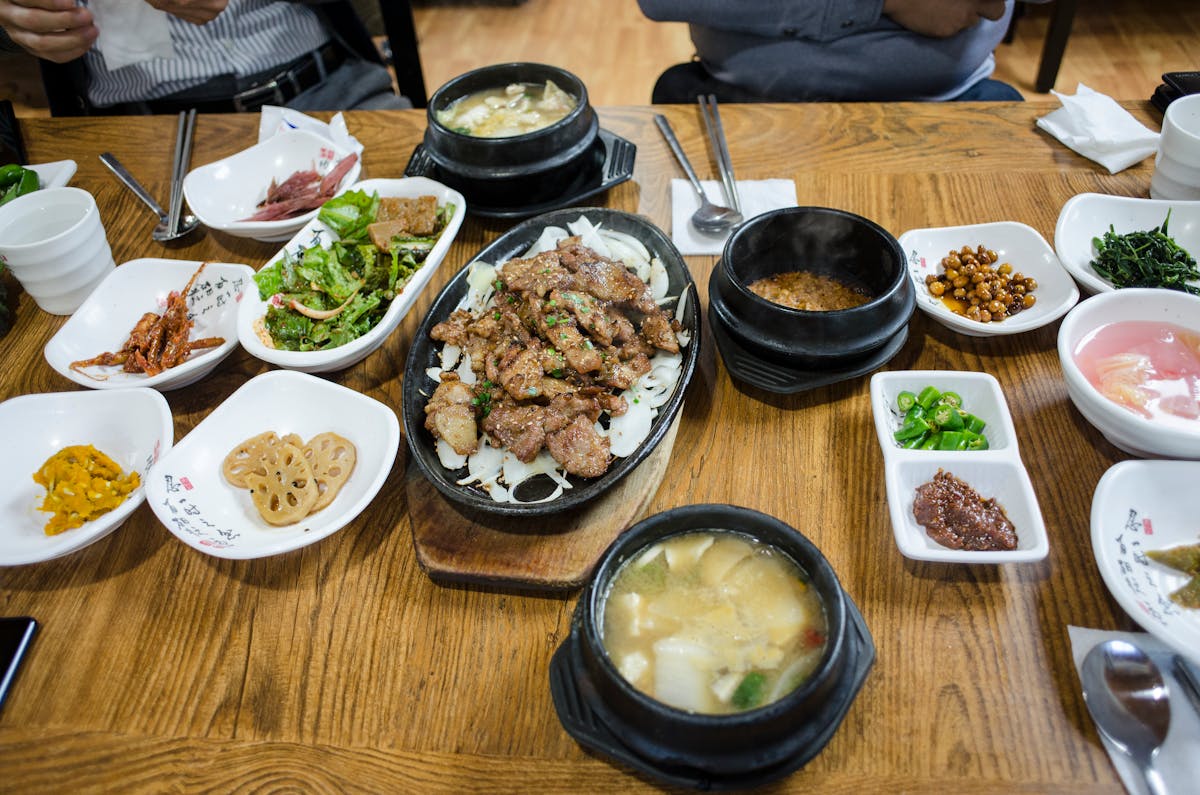

Every Korean food guide is written for tourists. What to try, what’s “must-eat,” which dishes are most popular. That’s useful. But I work in an office in Seoul with 10 people who eat Korean food every single day, and the conversations at lunch are nothing like what the travel blogs describe.
So I asked them. Not formally — no survey forms. Just over two weeks of lunch conversations, I asked each of them the same three questions: what do you actually eat on a typical workday, what did you order last week, and what do you refuse to eat at 회식 (hwesik — office dinner). Here’s what they said.
This is not scientific. These are 10 people I work with in Seoul. But that’s the point — actual people, not travel guides.
What Seoul Office Workers Actually Eat for Lunch
The first thing that surprised me when I started asking: the range was smaller than I expected. Most people in my office cycle through maybe 5-7 dishes on rotation. Not because they’re uncreative — it’s because ₩8,000~₩10,000 is the de facto lunch budget for a Korean office worker, and that budget self-selects toward certain categories.
Seven out of ten people said their lunch budget is between ₩8,000 and ₩10,000. Two said they go up to ₩12,000 if it’s a special occasion or a client. One colleague is very strict about ₩7,000 maximum and always finds a way.
The most common actual lunch dishes in order of how often they came up:
- 된장찌개 (doenjang jjigae) with rice — Four out of ten mentioned this. It’s consistent, filling, and ₩7,000~₩8,500 at a neighborhood place. Two of them said they eat it multiple times a week without getting tired of it.
- 김치찌개 (kimchi jjigae) — Similar price range, similar frequency. One colleague made the distinction: “doenjang in winter, kimchi when it’s warm.” I have no idea if that’s a personal rule or a real thing, but it tracks with what I do too.
- 국밥 (gukbap — rice soup) — Three people mentioned this, specifically 순대국밥 (blood sausage rice soup) or 돼지국밥 (pork rice soup). The cheapest reliable lunch option at ₩6,500~₩7,500. One said he goes here when he doesn’t want to think about what to eat.
- 배달 (delivery) — Two people eat at their desk most days, ordering through Baemin or Coupang Eats. Their most frequent order: 제육볶음 (spicy pork stir-fry) or 돌솥비빔밥 (hot stone bibimbap). Delivery adds ₩2,000~₩4,000 in delivery fees, so they tend to pick slightly more expensive dishes when ordering.
What Gets Ordered Most at Office Delivery
I asked specifically about delivery orders because this is data you genuinely can’t get from travel guides. Tourist recommendations are about what to eat at restaurants. What Korean office workers order to their desks is a different list entirely.
Top 3 delivery orders in my office (by frequency mentioned):
- 제육볶음 (jeyuk bokkeum) — Spicy stir-fried pork over rice. Every single person who orders delivery mentioned this at least sometimes. It travels well, reheats okay if you eat it fast, and it’s usually ₩8,000~₩9,000 including banchan. “Basically never bad” was the consensus.
- 족발 and bossam (trotters and boiled pork) — This sounds surprising for a regular lunch, but apparently it’s common for team orders when multiple people order together. It scales well and it’s the kind of thing that feels like a reward on a hard week.
- 김밥 and 떡볶이 combo — The bunsik combo. Not glamorous, but three people in my office order this at least once a week. ₩6,000~₩7,000 range. One colleague said: “I know it’s not impressive but it’s exactly what I want on a Friday.”
What Nobody Eats at 회식
This is where things got interesting. 회식 is a Korean office tradition — the mandatory(ish) group dinner where the team goes out together, usually paid for by the team budget or by the manager. The food choices are usually Korean BBQ, pork belly (삼겹살), or 보쌈.
I asked what people avoid at these dinners. Honestly, the most common answer surprised me.
Three people said they avoid 곱창 (gopchang — grilled intestines) if it comes up as an option. Not because they hate it — a few said they’d eat it with close friends — but because it’s polarizing and company dinners are not the place to test whether your senior colleague is going to make a face at your food. “I eat it outside of work. At hwesik, I just don’t want the conversation.”
Two people avoid 홍어 (fermented skate fish), which is the most aggressively funky fermented fish in Korean cuisine. One said: “If someone orders it, I leave and come back when they’re done.”
Interestingly, nobody said they avoid kimchi or anything that tourists often worry about being “too strong.” The office food avoidance is about texture or fermentation intensity, not spice level. Spicy is just normal here.
The Foreign Colleague Question
We have one colleague who moved to Seoul from Germany about three years ago. I asked her what took the longest to get used to.
Her answer without hesitating: fermented things at breakfast time. “Not the kimchi itself — I like kimchi now. But the first time someone put kimchi and some kind of fermented soybean thing in front of me at 8am, my brain couldn’t process it. Now I eat it every day. But that first month was a real adjustment.”
The second thing she mentioned: eating speed. “In Germany, lunch is at least 45 minutes. Here, my colleagues finish a full meal in 10-12 minutes and look at me like I’m slow. I’ve gotten faster but I’ll never be that fast.”
My honest take: she’s right on both counts. Korean meal pace, especially at a nearby 식당 during the lunch rush, is genuinely fast. You order, you eat, you leave. It’s not rude — it’s just the rhythm of a busy city. If you’re a visitor planning to eat like a tourist (slowly, looking at everything), go after 1:30pm when the lunch rush is over.
What This Actually Means for Visitors
If you want to eat what Seoul office workers eat — not what the tourist guides tell you to eat — the answer is simpler than the lists suggest: find a neighborhood 백반집 (baekban restaurant — home-style Korean set meal) near a residential or office area, order whatever the set is that day, and eat it fast. That’s the actual Seoul lunch experience.
The dishes that came up most in my colleagues’ answers — doenjang jjigae, kimchi jjigae, gukbap, jeyuk bokkeum — are all available in basically any Korean restaurant. They’re not exotic. They’re not “hidden gems.” They’re just what people eat. The travel blog version of Korean food makes it more complicated than it is.
For more context on what Korean food actually looks like day-to-day, the Korean BBQ guide covers the most visitor-focused part. And for street food that actually exists outside of tourist areas, the street food guide has the real options.
Conversations conducted May 2026. Ten colleagues, Seoul office. Not a representative sample — just the people I eat lunch near.

About Jay Han
Jay has lived in Seoul for over 10 years and works as a marketing professional. He started Korea Hub to share the kind of honest, specific information he wishes he’d had when navigating Korean culture, food, and travel for the first time. Not a travel blogger — just someone who actually lives here.
I actually did ask ten coworkers this question over lunch, across two different weeks. The range of answers was wider than I expected. A few of the responses surprised me.
More about Jay →