
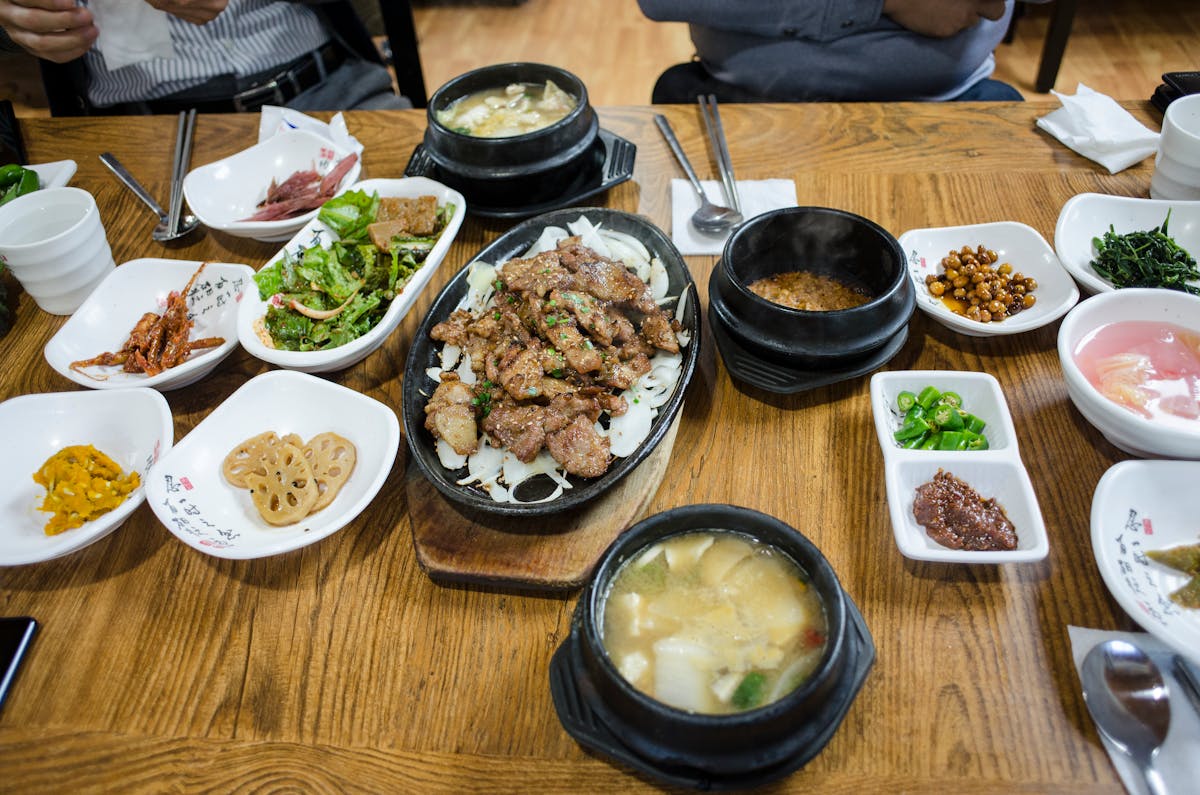

The first time I took a foreign friend to a Korean BBQ place, she sat down and immediately looked at the grill in the table and said, “are we supposed to cook this ourselves?” Yes. That’s the whole point.
Korean BBQ (삼겹살집, galbi places, KBBQ — whatever you want to call it) is not just food. It’s a whole situation. There are things you do in a specific order, things you don’t ask for because they just appear, and things that are genuinely confusing even to Koreans who haven’t done it in a while.
The Basic Setup
You sit at a table with a grill built into the center — either charcoal or gas, depending on the restaurant. Charcoal is generally considered better and you’ll sometimes see places advertising it. A server will come and ignite the grill, then return a few minutes later to start putting meat on it.
Side dishes (banchan, 반찬) appear automatically. No extra charge. These are typically kimchi, pickled vegetables, seasoned spinach or bean sprouts, and maybe a small bowl of doenjang jjigae (fermented soybean paste soup) or egg custard. You don’t order these — they come.
What to Order
The menu at a standard KBBQ place is shorter than you expect. The main items:
Samgyeopsal (삼겹살)
Thick-cut pork belly. This is probably the most commonly ordered item and is almost always available. Fatty, rich, cooks pretty fast. A portion is usually 13,000–18,000 won for around 200g, which sounds small but is genuinely filling when combined with rice and sides.
Galbi (갈비)
Short ribs — pork or beef. Beef galbi (소갈비) is significantly more expensive, often 30,000–50,000 won per portion. Pork galbi (돼지갈비) is closer to 15,000–20,000 won. The flavor is usually marinated, so it’s sweeter and more savory than plain samgyeopsal.
Chadolbaegi (차돌박이)
Thinly shaved beef brisket. Cooks in about 30 seconds on the grill. It’s lighter than pork belly and has a subtle beefy flavor. Often ordered mid-meal to change the pace. Around 15,000–22,000 won.
Makchang / Gobchang (막창/곱창)
Intestines — either large intestine (makchang) or small intestine (gobchang). Not for everyone, but if you’re open to it, the texture when cooked well is actually quite good: crispy on the outside, chewy inside. You’ll need to find a restaurant that specializes in this; not every KBBQ place serves it. Daegu is regionally famous for makchang, but Seoul has plenty of places.
How the Cooking Works
You don’t always cook it yourself. This depends on the restaurant. At more traditional places, the server will cook for you the entire time — they’ll check on the grill, flip the meat, and cut it with scissors right on the grill when it’s ready. Don’t be surprised by the scissors. Kitchen shears to cut meat is completely standard.
At newer, more casual places (especially in Hongdae, Itaewon, and near universities), you’re expected to do it yourself. The server will bring the meat and gesture to the grill.
When I first tried to cook galbi myself years ago, my biggest mistake was piling too much on at once. The grill temperature drops and you end up steaming instead of searing. Put a few pieces on, let them sear, then add more. Also, the grill grate needs to be replaced when it gets too burnt — ask the server, they’ll swap it. Don’t cook on a blackened-past-use grate.
How to Eat It
This is where it gets fun — or confusing if nobody shows you.
The Wrap (쌈, ssam)
Take a piece of lettuce or perilla leaf (깻잎, kkaennip). Put a small scoop of rice in it if you want, then a piece of meat, a small dab of ssamjang (the ferky, chunky paste that’s usually on the table), maybe a sliver of raw garlic or a piece of green chili. Fold it into a small bundle. Eat the whole thing in one bite if possible.
The one-bite rule is more cultural than a hard rule — nobody is going to say anything if you take two bites. But it’s the intention. The wrap is designed as a single serving.
Eating Without the Wrap
Totally valid. Plenty of Koreans don’t wrap every piece. Dip the meat in sesame oil mixed with salt and pepper (usually a small dish on the table), eat with rice, and go through the banchan. That’s also fine.
Garlic and Green Chili
Raw garlic slices and whole green chilies are usually on the table in a small bowl. The garlic is often placed directly on the grill alongside the meat to roast. Roasted garlic is significantly milder and sweeter — worth doing.
Drinks
Soju is the standard. A bottle is 4,000–6,000 won at restaurants. At a KBBQ place, you’ll see people drinking soju straight, mixed with beer (somaek), or just beer alone.
If you don’t drink alcohol, sikhye (식혜, sweet rice punch) or just water and soft drinks are fine — nobody will comment. I grabbed an americano after one of these dinners recently and the server gave me a look, but nobody said anything.
The drinking culture at KBBQ is casual but has some patterns — pouring for others before yourself, using two hands to receive a glass. These are polite gestures, not strict rules. If you do them, people will appreciate it. If you don’t, nobody will explain that you did anything wrong.
Costs and Realistic Expectations
A KBBQ dinner for two people, ordering two or three portions of meat plus drinks, typically runs 40,000–70,000 won total. That’s roughly $30–$50 USD. If you add expensive beef cuts or multiple rounds of soju, it goes up.
Tourist-area KBBQ (Myeongdong especially) can be 30–40% more expensive for the same thing. Not necessarily worse, just priced for foot traffic. I usually go to side streets in Mapo-gu or Mapogu neighborhoods near Mangwon for what I’d consider normal local prices.
Some places charge for rice separately (usually 1,000–2,000 won per person). Some include it. If you don’t see rice and you want it, just ask — “밥 주세요” (bap juseyo).
Etiquette Things That Actually Matter
You can share the grill. Most tables seat four people and the grill is in the middle. Ordering different meats for different people is normal — they’ll all go on the same grill.
Replace the grill when staff offers. When the grate is too charred, a server will bring a new one and swap it out. Let them do this. It improves the flavor and prevents burning.
The ventilation hood above the table — if there is one, the server will lower it at some point. This is so the smoke goes up and not into your face. The adjustment timing feels random but there’s usually a reason for it.
Don’t stick chopsticks upright in rice. That’s a funeral gesture. Lay them on the edge of the bowl or across the top.
Places Worth Going
My personal benchmark is that a place should be busy on a weekday evening with Korean customers. That’s usually a reliable quality indicator in my experience.
The area around Mapo-gu near Mangwon Station has several solid samgyeopsal spots that locals use. The back streets of Jongno have some older galbi restaurants that have been around for decades. Mapogu’s Mangwon Market vicinity for casual, Jongno 3-ga for more sit-down traditional options.
If you’re specifically looking for makchang or gobchang, search specifically for “막창집” or “곱창집” near your location — these are specialty restaurants and not every KBBQ place offers them.
Go with at least two people. KBBQ alone is technically possible but a bit sad. It’s genuinely a shared-table, pass-the-soju type of meal. The whole experience is designed around a group of people eating the same grill together.
Last verified: May 2026. Information confirmed through direct experience and current sources. Something changed? Leave a comment and I’ll update it.

About Jay Han
Jay has lived in Seoul for over 10 years and works as a marketing professional. He started Korea Hub to share the kind of honest, specific information he wishes he’d had when navigating Korean culture, food, and travel for the first time. Not a travel blogger — just someone who actually lives here.
Korean BBQ is the social format I’ve used more than any other in Seoul — work dinners, friend gatherings, first meetings. I’ve sat at probably a hundred different grills at this point.
More about Jay →