
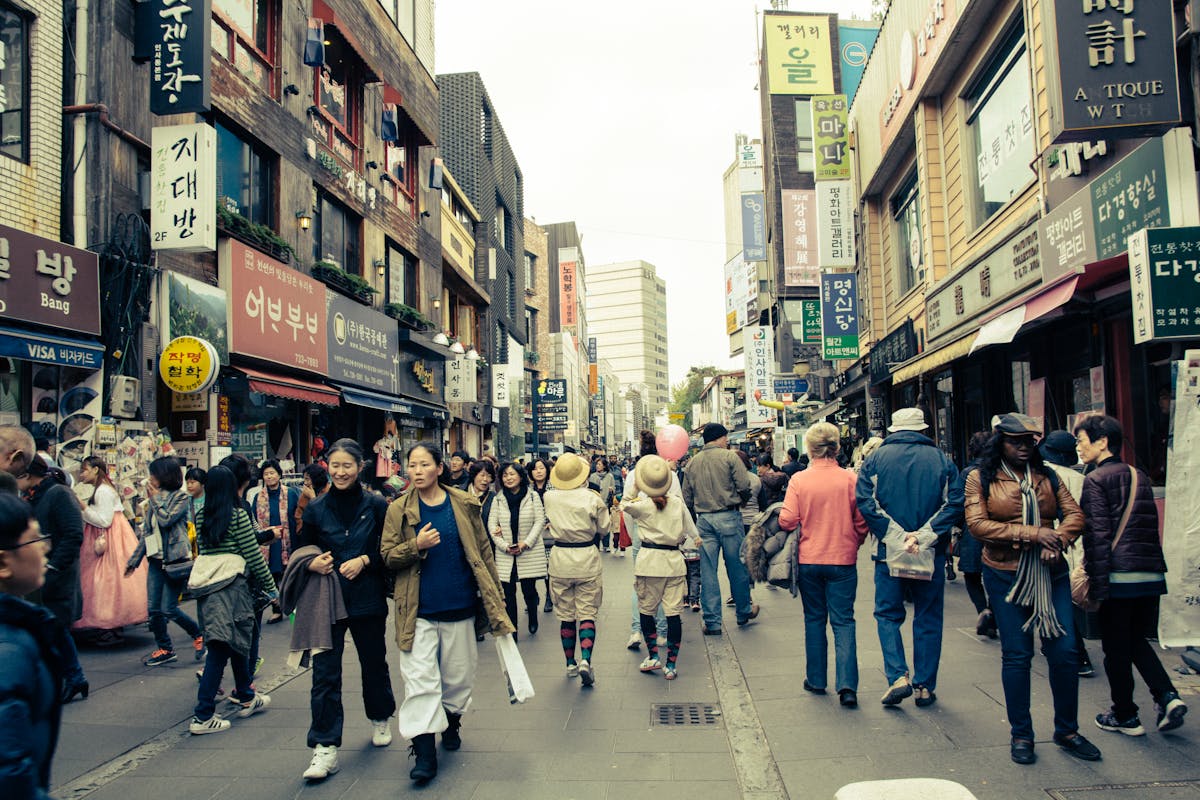

Sinchon is the neighborhood I’d point someone toward if they said they wanted to actually spend time in Seoul without going broke. Not because it’s lacking anything — the food scene alone is worth coming for — but because the whole economy of the area is calibrated around students from Yonsei, Ewha Womans University, Sogang, and Hongik, which means the market has been disciplined by generations of people who have specific demands (good, fast, filling, cheap) and will walk to the next street if those demands aren’t met.
When I first visited Sinchon, I was coming from a few days in the Myeongdong and Insadong area and I’d already started feeling the kind of tourist-economy fatigue where everything is slightly more expensive and slightly more oriented toward a forty-minute stay. Sinchon reset that. It’s noisy, dense, occasionally chaotic, and has an energy that comes from actual young people doing actual young-person things rather than performing activities for visitors.
The Geography
Sinchon Station is on Line 2. The neighborhood radiates from there, with the main commercial street (Sinchon-ro) running northward toward Yonsei University’s main gate. The university itself is worth walking into — the campus is older and more architecturally interesting than you might expect, with stone buildings from the early twentieth century mixed with modern additions and a central plaza where students gather and occasionally hold protest events, which is a tradition at Korean universities that goes back decades.
Ewha Womans University is about a ten-minute walk west of Sinchon Station, and the street leading to its main gate (Ewhayeodae-gil) has its own distinct character — slightly more fashion-oriented than Sinchon proper, with a concentration of cosmetics shops, boutique clothing, and cafés that reflect Ewha’s student demographics. The campus itself is architecturally notable: the ECC (Ewha Campus Complex) is a partially underground building designed by Dominique Perrault that splits the hillside open. It’s worth walking through even if you don’t know architecture.
Food: The Actual Reason
Let me be specific because vague praise for food doesn’t help anyone plan a visit. Here is what is reliably available in Sinchon for under 10,000 won per person:
Sundubu jjigae (soft tofu stew, spicy, served bubbling in a stone pot with egg cracked in at the table) — around 8,000 to 9,000 won. There are three places on a single block near Yonsei’s main gate that each argue they’re the original, which is probably not all true but the stew is good at all of them. Gukbap (rice in broth, with pork or beef) — around 7,000 to 9,000 won, eaten fast standing or at basic plastic stools, deeply satisfying. Dak-galbi (spicy stir-fried chicken with rice cakes and vegetables cooked on a flat pan at the table) — around 10,000 to 12,000 won per person for the basic set, significantly better with the fried rice cooked in the remaining sauce at the end, which you should always order.
The dak-galbi concentration in Sinchon is real — there’s an entire street known locally for it, running just east of the main strip. I was surprised to find how much variation exists between places that appear to be serving the same dish; the quality of the gochujang paste they use makes a significant difference. The ones with visible queues at dinner time are usually worth the wait, which runs 10 to 20 minutes on a Friday evening.
The bar and restaurant situation after 8pm in Sinchon is dense and competitive, which keeps prices honest. The areas around the main street and the blocks toward Yonsei have pojangmacha (tent bars) selling anju (drinking food) and soju from late afternoon until well past midnight. A bottle of soju costs around 4,000 to 5,000 won at these places; the anju of spicy rice cakes or grilled meat runs 7,000 to 15,000 won. This is where you come if you want to drink the way Koreans actually drink, which is to say communally, with food, at low plastic tables, until you’ve lost track of whether it’s late evening or early morning.
The Drinking Culture (Since We’re Being Honest)
Sinchon is one of Seoul’s classic drinking neighborhoods, and understanding this helps you understand what the area is and isn’t. On Thursday through Saturday nights, the student population converges here in numbers that make navigating the main street an exercise in patience. This is fine — it’s energetic and generally good-natured — but if you’re looking for a quiet dinner on a Friday evening, you might need to plan your reservation or arrive before 6:30pm.
My biggest mistake in Sinchon was arriving on a Saturday night expecting to browse at my leisure. Instead I spent twenty minutes finding a restaurant that had seats available, then another ten minutes accepting that the noise level was going to be what it was. None of this was bad exactly, but managing expectations early would have helped.
The craft beer scene has arrived in Sinchon, as it has in most Seoul neighborhoods. There are several craft beer bars near the Yonsei entrance that serve Korean craft beers (the industry has grown significantly since the mid-2010s) alongside imports. Expect to pay 7,000 to 12,000 won for a proper pint of something interesting, which is more than a convenience store beer but still less than equivalent quality beer in most European or North American cities.
Yonsei University Campus
I want to make the case for actually walking into the campus, which many visitors treat as optional scenery rather than a destination. Yonsei was founded in 1885 (originally by an American missionary doctor, which explains some of the early building styles) and the campus has a dignity and green space that’s rare in central Seoul. The central lawn in spring, with cherry blossoms along the edges and students studying or sleeping on the grass, is one of the nicer scenes the city offers.
The Underwood Memorial Hall (the old building you’ll see on most photographs of Yonsei) is genuinely beautiful and open during the day. There are cafés on campus serving students — prices are among the cheapest you’ll find in Seoul, because they’re priced for students who eat there three times a day. A coffee at the student union building runs around 2,500 to 3,500 won, which, for reference, is about 40% less than the same drink at a commercial café half a block away.
Hongdae: Right Next Door
Sinchon and Hongdae are adjacent neighborhoods and in practice their edges have blurred significantly. Walking from Sinchon Station toward Hongdae Station takes about twenty minutes on foot and you’ll pass through the transition zone where the student-oriented budget restaurants of Sinchon gradually shade into the creative and nightlife-oriented businesses of Hongdae. This makes them easy to combine in a single day — a Sinchon lunch, an Hongdae afternoon in the art spaces and cafés, a Sinchon or Hongdae evening depending on what kind of evening you want.
The two neighborhoods offer complementary rather than identical experiences. Sinchon is more practical, more purely campus-adjacent, less self-consciously creative. Hongdae is more styled, more music and art focused, has a higher density of both excellent cafés and very expensive ones. Knowing the difference lets you allocate your time well.
Shopping on a Budget
If you need to buy everyday things in Seoul without paying tourist prices, Sinchon is an excellent base. The underground and street-level shops near the station carry clothing, accessories, phone cases, and cosmetics at prices aimed at students. Korean skincare products — face masks, serums, moisturizers — from the major Korean brands (Innisfree, Etude House, Nature Republic) are available here for 3,000 to 15,000 won per item, which is considerably less than you’d pay for equivalent imported products at home.
The vintage and second-hand clothing market in Sinchon is less developed than Hongdae’s, but there are a handful of good shops in the streets between the two neighborhoods that do a consistent selection. Prices are a bit lower than Hongdae equivalents because the foot traffic is slightly less — worth checking if you’re in the area.
Getting There and Practical Notes
Sinchon Station is Line 2, green line. From Hongdae it’s one stop east (2 minutes). From Gangnam it’s about 30 minutes. From Myeongdong, about 20 minutes via transfer at Euljiro. From Incheon Airport via the Airport Railroad, you can transfer at Hongik University Station and take one stop east to Sinchon — about 60 minutes total from the airport, no transfers on Line 2 once you’re on it.
The neighborhood is walkable in the core area. For getting to Ewha’s campus, the 10-minute walk is easy and passes through genuinely interesting streets. For getting to Hongdae, walk or take the subway one stop depending on your energy level.
Accommodation in and around Sinchon tends to run cheaper than equivalent options in Myeongdong or Insadong. Guesthouses and small hotels in the 50,000 to 80,000 won per night range are available here that would cost 80,000 to 120,000 won closer to the traditional tourist center. If budget is a genuine constraint and you’re comfortable navigating by subway, staying here is worth considering — you’re still only 20 to 30 minutes from anything central.
One note on noise: Sinchon is an active neighborhood at night. The main street is busy until 2 or 3am on weekends and the noise doesn’t fully disappear. If you’re a light sleeper staying nearby, ask specifically for a room facing away from Sinchon-ro when booking.
Last verified: May 2026. Information confirmed through direct experience and current sources. Something changed? Leave a comment and I’ll update it.

About Jay Han
Jay has lived in Seoul for over 10 years and works as a marketing professional. He started Korea Hub to share the kind of honest, specific information he wishes he’d had when navigating Korean culture, food, and travel for the first time. Not a travel blogger — just someone who actually lives here.
Sinchon is about twenty minutes from where I live and I used to go for cheap dinner fairly often in my first years in Seoul. The student energy there is different from anywhere else in the city.
More about Jay →