
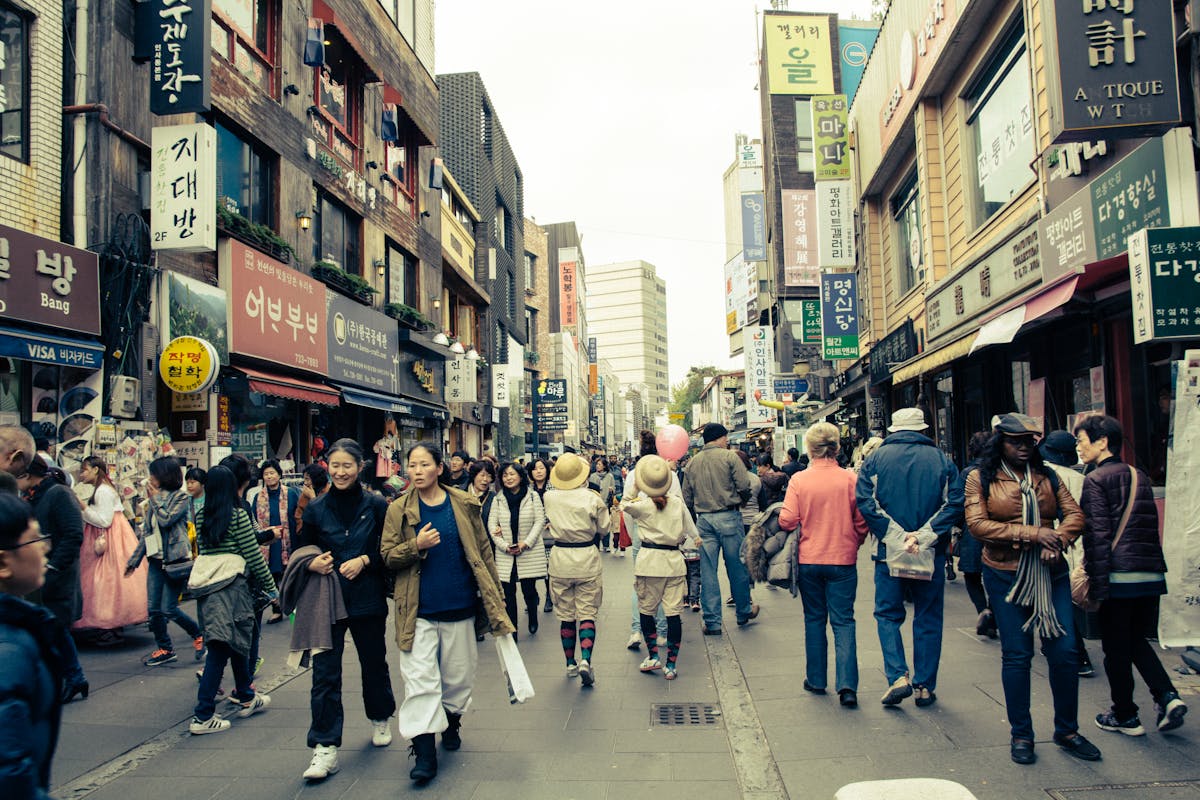

Hongdae is one of those places that resists easy description. It’s a university district — Hongik University is right there, hence the name — but calling it a “student area” misses about two-thirds of what actually happens there. When I first visited in 2019, I expected the usual café-and-convenience-store strip you find near most Korean campuses. What I got instead was a neighborhood that seemed to run on creative energy and stubbornly refuse any kind of sleep schedule.
The area radiates outward from Hongik University Station (Line 2, Airport Railroad, Gyeongui-Jungang Line), and depending on which exit you take, you land in a completely different vibe. Exit 9 drops you near the main drag, which by midday is already filling with street vendors, and by 10pm is — well, let’s just say finding elbow room gets ambitious.
What Hongdae Actually Is
Before anything else: Hongdae isn’t just a street. It’s a sprawling grid of maybe fifteen or twenty blocks where the density of interesting things to do per square meter is frankly absurd. There are distinct zones — the main club street, the “café alley,” the street art corridor along Wausan-ro, the more residential-feeling stretch near Yonsei that somehow still has four vintage clothing shops and a tiny live jazz bar.
I was surprised to find how many actual working artists and musicians base themselves here. The name comes from Hongik University’s fine arts program, which has been pumping graduates into the neighborhood since the 1980s. Some stayed. A lot of them opened small galleries or studios on second and third floors of buildings, spaces you only find because you wandered off the main path or saw a handwritten sign in a stairwell.
The street art is real, not the sanitized mural-district kind. There are commissioned pieces, sure, but also plenty of stuff that showed up overnight and might be painted over next week. The area around Eoulmadang-ro is particularly dense with it — walls, shutters, the occasional telephone box.
The Music Scene
This is where Hongdae earns its reputation. The live music venues here aren’t tourist traps; they’re actual working clubs and small stages where bands play because this is where you play in Seoul if you’re serious. Cover charges typically run 10,000 to 20,000 won, and that usually includes a drink. The shows at smaller venues often start around 8 or 9pm and run until the neighborhood’s curfew becomes a suggestion, which is to say, quite late on weekends.
Club FF, Club Bbang, and Freebird are consistently mentioned when local musicians talk about where things actually happen. I’ve seen everything from post-rock acts to solo acoustic sets in spaces that hold maybe eighty people. The intimacy is part of it — you’re close enough that if the guitarist hits a wrong note, you’ll definitely know.
Free outdoor performances happen near the main entrance plaza on weekends, especially during warmer months. These range from busking to fully staged mini-concerts organized by student groups. The quality varies wildly, which is part of the charm.
Art Spaces and Galleries
There are so many here that you could spend a full day just doing galleries and not cover them all. Most are free or ask a small donation at the door. The Sangsangmadang building (look for the weird concrete structure that resembles a stack of shipping containers — it’s near the main street) has multiple floors of exhibition space plus a cinema and performance hall. It’s run by KT&G, and yes, that’s a tobacco company, but the programming is genuinely interesting.
Smaller, independent gallery spaces tend to cluster on the side streets off Wausan-ro. My biggest mistake was assuming the interesting ones would have English signage or obvious exteriors. Several of the best I found had nothing but a Korean name card slid into a door frame, and inside was a solo show by someone whose work I’d genuinely want to own if it weren’t for shipping logistics and, you know, money.
The design shops in this area are also worth noting, particularly if you’re interested in Korean independent designers. There’s a concentration of them on the streets leading toward Hapjeong that sells clothing, accessories, and small homeware items you won’t find in the usual tourist corridors. Prices reflect the quality: expect to spend 40,000 to 150,000 won on clothing pieces from smaller labels.
Food and Cafés
The café situation in Hongdae is, frankly, overwhelming. Within three blocks of Exit 9 you can find specialty coffee shops, cafés themed around specific cartoon characters or movie properties, boba tea chains, and old-school pojangmacha-style spots selling canned coffee from a metal cart. The specialty coffee places are legitimate — third-wave roasting, careful extraction, baristas who will talk to you about origin notes if you let them. Most cups run 5,000 to 8,000 won.
For food proper, the area has both ends of the spectrum. Late-night street food runs cheap — 3,000 won for tteokbokki, 2,000 won for hotteok, 5,000 to 8,000 won for a serving of tornado potatoes or cheese corn. Sit-down restaurants cluster slightly off the main drag; the Korean BBQ spots in the blocks behind the main street are generally better value than the ones right on the tourist corridor, and around 15,000 to 20,000 won per person gets you a solid meal with sides and rice.
There’s a small market-style food alley near Hongik University Station Exit 8 that gets busy on weekend afternoons. It’s not a traditional market — it’s young vendors selling handmade things alongside street food — but the energy is good and the prices are reasonable.
Shopping
Hongdae is not a luxury shopping destination. What it is is excellent for vintage clothing, independent Korean fashion brands, music merchandise, art prints, and the kind of small handcrafted items that make decent gifts if you’re trying to avoid buying another Korean flag fridge magnet. The vintage stores range from genuinely curated (and priced accordingly, 30,000 to 80,000 won for a good piece) to chaotic bins where if you have patience and time you can find wearable things for 5,000 won.
Several stores specialize in local indie band merchandise and vinyl — actual pressing plant vinyl, not just Korean pop product — which is worth knowing if you’re a music person and want to bring something home that isn’t available elsewhere.
Getting Around Within the Neighborhood
Hongdae is entirely walkable if you’re prepared to walk. The main area spans probably two kilometers across if you include Sangsu and the edge of Hapjeong, which have started blending into the Hongdae zone as the neighborhood expanded over the last decade. Comfortable shoes are non-negotiable — the streets are mostly flat but you’ll cover a lot of ground without noticing.
Kakao Bike stations are scattered through the area if you want to extend your range. A 30-minute ride costs around 1,000 to 1,500 won, depending on your membership status.
Timing Your Visit
This matters more here than most Seoul neighborhoods. Weekday afternoons are calm, pleasant, and give you actual space to browse and think. Saturday afternoon is busy but navigable. Saturday night is controlled chaos, and I mean that semi-affectionately — the energy is real and if you’re prepared for a crowd, it’s an experience. Sunday morning, specifically before noon, is when the neighborhood recovers: empty streets, a few cafés open early, the occasional street cleaner.
The best light for the street art is late afternoon in autumn and early spring when the sun angle is lower. If you’re photographing the murals, that golden hour window is worth timing for.
Practical Notes
The nearest subway is Hongik University Station, served by three lines (Line 2, the Airport Railroad from Incheon, and the Gyeongui-Jungang Line). From Myeongdong it’s about 25 minutes on the subway. From Gangnam it’s around 30 minutes via Line 2.
ATMs are everywhere. The GS25 and CU convenience stores have them and accept international cards with the usual foreign transaction fees. Cash is still preferred at a lot of the smaller venues and street food stalls.
The neighborhood is generally safe at all hours, including late night. The main street gets rowdy rather than dangerous — mostly people who’ve had a few drinks being loud rather than aggressive. Standard urban awareness applies.
One last thing: if someone approaches you near Exit 9 trying to hand you a flyer for a club, the clubs they’re promoting are usually cover-heavy tourist traps. The places the flyer people don’t advertise are generally the better ones.
Last verified: May 2026. Information confirmed through direct experience and current sources. Something changed? Leave a comment and I’ll update it.

About Jay Han
Jay has lived in Seoul for over 10 years and works as a marketing professional. He started Korea Hub to share the kind of honest, specific information he wishes he’d had when navigating Korean culture, food, and travel for the first time. Not a travel blogger — just someone who actually lives here.
I’ve been to Hongdae at least once a month for years — for work events, weekend evenings, and occasionally just to walk around. It’s changed more than almost any other neighborhood I know in Seoul.
More about Jay →